Analyzing Graph Transformations of Functions in Algebra
This resource provides a detailed examination of graph transformations and function notation. It includes step-by-step instructions on identifying parent functions, describing transformations, and sketching graphs. Specific examples involve quadratic and cubic functions, showcasing how to represent transformations in function notation. Key features include identifying parent functions, detailing transformation sequences, and utilizing visual sketches to illustrate changes on the graph. Essential for students learning function transformations in algebra, this guide enhances understanding through practical applications.

Analyzing Graph Transformations of Functions in Algebra
E N D
Presentation Transcript
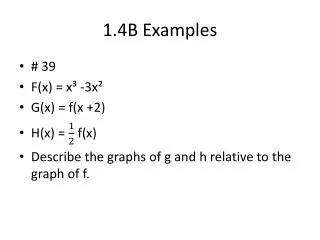
1.4B Examples • # 39 • F(x) = x³ -3x² • G(x) = f(x +2) • H(x) = f(x) • Describe the graphs of g and h relative to the graph of f.
1.4 B More Examples • # 43 g(x) = 2 – (x+5)² • A.) Identify the parent function f • B.) Describe the sequence of transformations from f to g. • C.) Sketch the graph by hand. • D. ) Use function notation to write g in terms of the parent function f.
More examples • # 53. g(x) = -2 I x – 1 I – 4 • A.) Identify the parent function f • B.) Describe the sequence of transformations from f to g. • C.) Sketch the graph by hand. • D. ) Use function notation to write g in terms of the parent function f.
More examples • # 55. - - 1 • A.) Identify the parent function f • B.) Describe the sequence of transformations from f to g. • C.) Sketch the graph by hand. • D. ) Use function notation to write g in terms of the parent function f.