Download
1 / 27
270 likes | 371 Vues
This presentation covers groundbreaking results from the Belle experiment, focusing on the first observations of the decay processes B → K1γ, B → K(1)γ, and B → ργ. These processes, which are forbidden at tree level in the Standard Model, show sensitivity to New Physics phenomena. The analysis includes detailed discussions on the photon spectrum, B-meson decay kinematics, and the suppression of continuum backgrounds. The research highlights event reconstruction techniques and the theoretical implications of mixing angles in these decays, contributing significantly to the field of flavor-changing neutral currents.

E N D
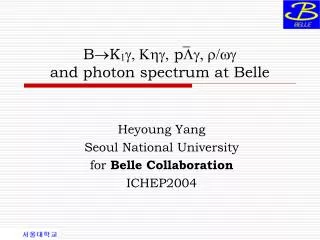
BK1g, Khg, pLg, r/wg and photon spectrum at Belle Heyoung Yang Seoul National University for Belle Collaboration ICHEP2004
Introduction to bs(d)g • FCNC process forbidden at tree level in SM sensitive to New Physics • B-factory experiments best experiment to measure FCNC e+e- collider experiment - good background suppresion with high Luminosity ICHEP2004-08-17
Results on FCNC at Belle • bsg • First observation of BK1g • First observation of BKhg • First observation of BpLg • photon spectrum • bdg • Search for Br/wg ICHEP2004-08-17
bs(d)g analysis tool DE Mbc • Kinematic constraints • E = E*B ― E*beam • Mbc= (E*beam)2 ― |P*B|2 • Continuum suppression with event shape parameters • B flight angle (cosqB) • Fisher discriminant • Particle ID with ACC/TOF/CDC cosqB Fisher ICHEP2004-08-17
First Observation of BK1g with 140/fb
BK1g • Known exclusive 2-body decay of bsg process • BK*(892) g (K*(892) Kp) • BK2*(1430) g (K2*(1430) Kp) • Possible 2-body decays : BK1g • K1: axial vectors, mixing states of K1A & K1B K1(1270) = K1A cosq + K1B sinq K1(1400) = K1A cosq – K1B sinq • K1(1270) Kr (rpp) (42%) • K*p (K*Kp) (16%) • K0*p (K0*Kp) (48%) • Kpp ( 83%) K1(1400)K*p (K*Kp) (94%) Kpp ( 94%) ICHEP2004-08-17
BK1g • Theoritical predictions (e.g) S.Veseli and M.G.Olsson PLB 367, 309(1996) • B[BK1(1270) g] =(1.200.44) 10-5 • B[BK1(1400) g] =(0.580.26) 10-5 H.Y.Cheng and C.K.Chua PRD 69, 094007(2004) • sensitive to their mixing angle • B[BK1(1270) g] =(0.770.11) 10-5(or (0.020.02) 10-5 ) • B[BK1(1400) g] =(0.080.04) 10-5 (or (0.800.12) 10-5 ) ICHEP2004-08-17
Inclusive BKppg +0.4 -0.2 • B[B+K+p-p+g] =(2.40.5 )10-5 by Belle, 29.1/fb PRL 89(2002) • Reanalysis for K+p-p+g / Ks0p-p+g with 140/fb 318.222 B+K+p-p+g 67.49 B0K0p-p+g First Observation ICHEP2004-08-17
BK1g • MKpp distribution for the search of K1(1270) or K1(1400) • K1(1270)Kr (42%) /K1(1400)Kr (3%) 0.6<Mpp<0.8GeV • K1(1270)K*p (16%) /K1(1400)K*p (94%) 0.8<MKp<1.0GeV • 2D Unbinned fitting with Mbc& MKpp 0.6<Mpp<0.8GeV 0.8<MKp<1.0GeV Mbc Mbc Total K2*(1430) NR + b2s,K* feed continuum+BBbar K1 signals K1(1270) MKpp MKpp K1(1400) 101.622 K1(1270) 22.726 K1(1400) ICHEP2004-08-17
BK1g FirstObservation (1.0<MKpp<2.0 GeV ) ICHEP2004-08-17
First Observation of BKhg with 140/fb
BKhg • Kshg can be used for the time-dependent CP asymmetry study • Event reconstruction as K+(Ks0)hg , (hgg, hp+p-p0 ) 45.011.0 BKhg First Observation (MKh<2.4 GeV) ICHEP2004-08-17
BKhg • MKh distribution for possible resonance • Enhancement around MKh 1.8GeV but not significant K3*(1780) ? 1.6<MKh<1.95 GeV ICHEP2004-08-17
First Observation of BpLg with 140/fb
BpLg • Radiative baryonic B decay, BpLg / BpS0g • 2D unbinned fitting with E & Mbc Theoretical prediction: * Pole Model: Phys.Lett. B533 (2002) B(B pΛg) ~ 1.2x10⁻⁶ B(B pΣ0g) ~ 2.9x10⁻⁹ *QCD counting rules: (hep-ph/0405283) B(B pΛg) ~ (1.2-2.4)x10-7 B(B pΣ0g) ~ (2.8-6.5)x10-7 34.17 B+pLg ICHEP2004-08-17
BpLg First Observation Details will be covered by M.-Z.Wang at next talk. (MpL < 2.4 GeV/c2 for B+pLg) (MpL<4.0 GeV/c2 for B0pS0g) ICHEP2004-08-17
Photon spectrum of bsg with 140/fb
Photon spectrum of bsg • Full inclusive reconstruction for only Egspectrum • Measure Eg of highest mementum photon • veto photons from p0 and h • apply event shape cuts to suppress continuum b.g. • cut optimized by using 15/fb off-resonance data • Photon energy spectrum measurements: • CLEO : 9/fb, Eg > 2.0 GeV • Babar : 54/fb, Eg > 2.1 GeV • new result from Belle : 140/fb, Eg > 1.8 GeV ICHEP2004-08-17
Photon spectrum of bsg After subtraction and efficiency correction Data B [BXsg] = (3.550.32 )10-4 < E > = 2.2920.0260.034GeV <E2>-<E>2 = 0.0305 0.0074 0.0063GeV2 +0.30 +0.11 -0.31 -0.07 PRL93,061803(2004) ICHEP2004-08-17
Search for Br/wg with 253/fb
Search for Br/wg • bdg suppressed in SM by |Vtd/Vts|2 • |Vtd/Vts|2 by B(Br(w)g)/B(BK*g) • large direct CP violation is predicted in bdg Ali and Parkhomenko, Eur.Phys.J. C23 (2002) 89-112 Bosch and Buchalla, Nucl.Phys. B621 (2002) 459-478 ICHEP2004-08-17
Search for Br/wg signal LR • Event reconstruction r0(p+p-)g/r+(p+p0)g/w(p+p-p0)g • with special continuum suppression • Fisher & cosqB & Dz of B-vertex LR(Likelihood Ratio) • 2D optimization with LR & QR(Quality of flavor tag) continuum QR ICHEP2004-08-17
Search for Br/wg B rp0 suppression by helicity cut BK*g suppression by MKp cut BG BG signal ICHEP2004-08-17
Search for Br/wg with 253/fb • For check of analysis method using BK*(892)g study • B[BK*(892)g] = (37.2 1.8) 10-6 good agreement with World Average ICHEP2004-08-17
Search for Br/wg with 253/fb Simultaneous unbinned fitting for r+g / r0g / wg assuming their isospin relations Total significance 1.9 s B+r+g B0r0g Bwg ICHEP2004-08-17
Search for Br/wg with 253/fb ICHEP2004-08-17
Summary • First observations of • B+K1(1270)+g / inclusive B0K0p+p-g • BKhg • B+pLg • Upper limits of • B+K1(1400)+g • BK3*(1780)g • B0pS0g • Brg / Bwg • |Vtd/Vts| • Measured photon spectrum of bsg ICHEP2004-08-17