Enhancing Education through Clemson's Laptop Program
Clemson University's Laptop Program aims to transform student learning and engagement by integrating laptops into the classroom. This initiative encourages the development of essential skills such as communication, technology proficiency, team building, and lifelong learning. With a focus on convenience and professional practice, the program introduces innovative teaching methods, including hybrid exams, studio courses, and online assessments. Faculty members are encouraged to adopt best practices while addressing potential challenges. Ultimately, the program fosters a dynamic educational environment that prepares students for future careers.

Enhancing Education through Clemson's Laptop Program
E N D
Presentation Transcript
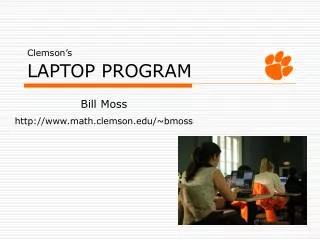
Clemson’sLAPTOP PROGRAM Bill Moss http://www.math.clemson.edu/~bmoss
Why Laptops?To build a better product • Laptop students have better … • Communication skills • Technology skills • Team building skills • Life-long learning skills
Why Laptops?To enhance the classroom … • Laptop course characteristics • Studio courses • Integrated lab and lecture • On-line quizzes and exams • Hybrid exams
Why Laptops?To slow the growth of IT costs • Where are the IT dollars going? • Keeping labs up-to-date • Printing costs • Storage costs • Support of multiple platforms
Why Laptops?Convenience, professional practice • Students see advantages to the laptop even when they have no laptop courses. • Mobility • Small foot-print • Laptops are becoming standard in business, law, medicine, and engineering practice.
Laptop Program Best Practices • Student mandate, faculty opportunity. • Provide for faculty development. • Early adopter faculty should offer “best fit” courses first. • Not all courses have to be laptop enhanced.
Faculty: FAQ • Is the laptop a distraction? When does the technology detract from the teaching of content? • What are the potential classroom logistical problems? • Can technology encourage students to be more independent, exploratory learners?
Research Base • How People Learn, Brain, Mind, Experience, School, National Research Council, National Academy Press, 2000.
Studio Calculus III The Calculus of the 3D World • Visualization is a strand that runs through the entire course. • Students build 3D solids by constructing their bounding surfaces, one surface at a time. • This course is more technically advanced than the traditional pencil and paper course.
Characteristics • Reduced lecture: 10-15 mini-lectures • Course journal and Maple tutorials (TA graded) • Tutorials submitted via the WebCT dropbox • Low-stakes quizzes, individual and team • Team projects (peer instruction) • Coaching by instructor • Practice exams
Maple Tutorials Include • Instructional Objectives with suggested problems for each objective • Main mathematical points with examples worked by hand and with Maple • Course journal homework assignments • Maple problems to be worked at the end of the tutorial
Pedagogy • Students take responsibility for learning. • Coaching enhances formative assessment. • Taking attendance and learning names is easy, e-mail absentees during studio time. • Frequent quizzes increase engagement. • Peer instruction is a goal of team projects. • Studio time mixes individual and cooperative learning.