
SlideServe
Menu
Préférences
© SlideServe · v2026

Electric Force

gerda avatar
12 diapositives · 662 Views · Jul 29, 2014

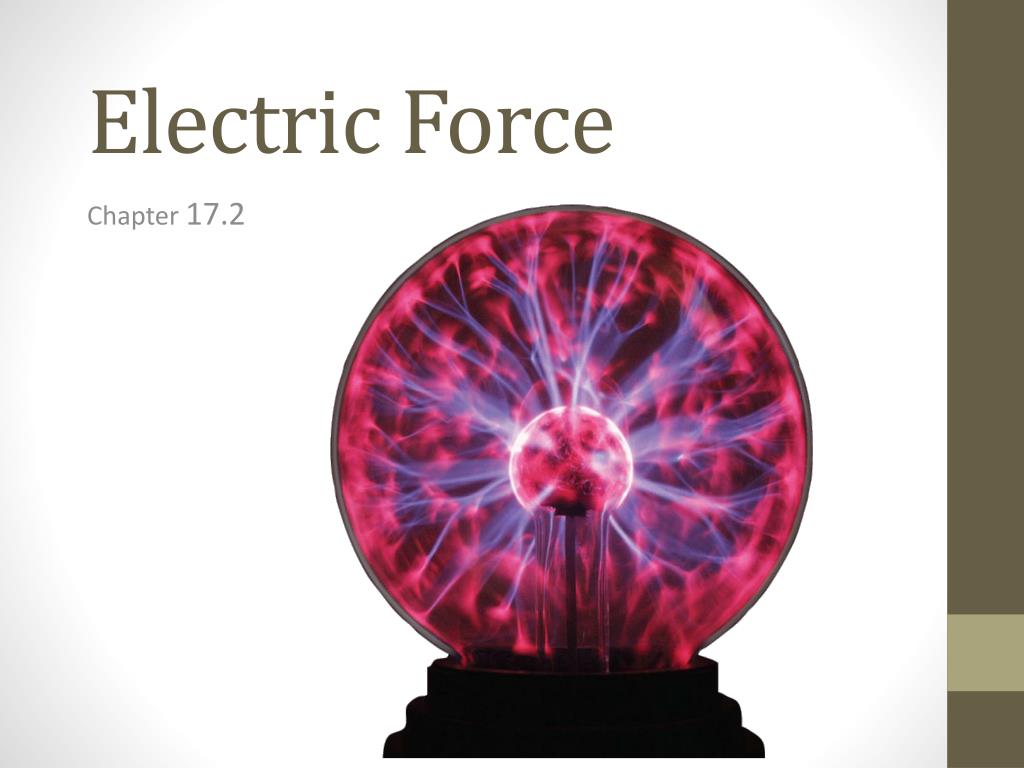
Electric Force. Chapter 17.2. Coulomb’s Law. Coulomb’s Constant . The proportionality constant k in Coulomb’s law is similar to G in Newton’s law of gravitation. k = 9,000,000,000 N·m 2 /C 2 or 9.0 × 10 9 N·m 2 /C 2
Electric Force - slide 1
01 / 12Electric Force
1 / 17

Télécharger la présentation

Electric Force
Une image / un lien ci-dessous est fourni (tel quel) pour télécharger la présentation

Politique de téléchargement : le contenu du site vous est fourni TEL QUEL pour votre information et votre usage personnel ; il ne peut être vendu, concédé sous licence ni partagé sur d’autres sites sans l’accord de son auteur.Le contenu vous est fourni TEL QUEL, pour votre information et votre usage personnel uniquement. Téléchargez la présentation en cliquant sur ce lien. Lors du téléchargement, si vous ne parvenez pas à télécharger une présentation, l’éditeur a peut-être supprimé le fichier de son serveur.Pendant le téléchargement, si vous ne parvenez pas à obtenir une présentation, le fichier a peut-être été supprimé par l’éditeur.

F I N

Plus de contenu associé

Transcription de la présentation
  1. Electric Force Chapter 17.2

  2. Coulomb’s Law

  3. Coulomb’s Constant • The proportionality constant k in Coulomb’s law is similar to G in Newton’s law of gravitation. • k = 9,000,000,000 N·m2/C2 or 9.0 × 10⁹ N·m2/C2 • If a pair of charges of 1 C each were 1 m apart, the force of repulsion between the two charges would be 9 billion newton. • That would be more than 10 times the weight of a battleship

  4. Gravity vs. Electricity • Newton’s law of gravitation for masses is similar to Coulomb’s law for electric charges. • Whereas the gravitational force of attraction between a pair of one-kilogram masses is extremely small, the electrical force between a pair of one-coulomb charges is extremely large. • The greatest difference between gravitation and electrical forces is that gravity only attracts but electrical forces may attract or repel.

  5. Rules for Coulomb’s Law • If the electrical force is negative, then it’s a attractive force. • If the electrical force is positive, then it’s an repulsive force. • Like charges repel and opposite charges attract. • Make sure that you enter all variables for Coulomb's Law in SI Units: • Charge – Coulomb’s (C) • Distance – Meters (m) • Force – Newton (N)

  6. Example Problem • A charged sphere with an excess charge of +5.5μC is placed 0.05m from another charged sphere, which carries a charge of -4.9μC. • What is the magnitude of the electrical force between the two charged spheres? • Is this a repulsive or attractive force? • How many excess electrons are on the negative sphere? • How many electrons has the positive sphere lost?

  7. Example Answer A What is the magnitude of the electrical force between the two charged spheres?

  8. Example Answer B Is this a repulsive or attractive force? • Because the elective force came out to be a negative answer, it means that the force will be attractive. • Opposites attractive, likes repel. Attractive

  9. Example Answer C How many excess electrons are on the negative sphere? -1C = 6.2x10¹⁸ Electrons

  10. Example Answer D How many electrons has the positive sphere lost? -1C = 6.2x10¹⁸ Electrons

  11. Electric Force is a Field Force • The electric force, just like the gravitational force, is a field force. • The force created by any charge can be measured at any radius around the sphere where the charge is at the center. • You can sense the force field that surrounds a charged Van de Graaff generator.

  12. Principle of Superposition • Superposition – The resultant force on any single charge equals the vector sum of the individual forces exerted on that charge by all the other individual charges that are present. • The method of finding the total force acting on a single charged particle is vector addition. • Solve for the total sum of the electrical forces in the x- and y-direction. • Then use the Pythagorean theorem and the tan function to find the magnitude and direction of the resulting force. • The positive and negative sign for each force just means if it is a repulsive or an attractive force. It doesn't not mean left or right. • It is best to draw a picture of the problem when solving.