Understanding the Reproductive Structures of Seed Plants
This unit explores the anatomy and functions of flowers, the reproductive organs of seed plants. Flowers consist of four specialized leaves: sepals, petals, stamens, and carpels. We discuss the roles of these structures in attracting pollinators, facilitating reproduction, and the processes of pollination, seed and fruit development, and dispersal. Additionally, the process of seed dormancy and germination is covered, along with vegetative reproduction techniques, including cuttings and grafting. Agriculture's reliance on specific crops for food supply is also highlighted.

Understanding the Reproductive Structures of Seed Plants
E N D
Presentation Transcript
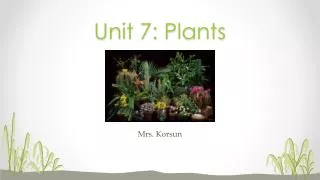
Unit 7 Plants Ch. 24 Reproduction of Seed Plants
Structure of Flowers • Flowers are reproductive organs composed of 4 kinds of specialized leaves: sepals, petals, stamens, & carpals
Sepals & Petals • Sepals - green leaves that enclose the bud before it opens, & they protect the flower while it is developing • Petals - often brightly colored, found just inside the sepals • Attract insects & other pollinators to the flower
Stamens & Carpels • Stamen - the male parts, consist of an anther & a filament • Filament - a long, thin stalk that supports the anther • Anther - found at the tip of each filament, where pollen grains are formed
Stamens & Carpels • Carpels - (pistils) - the female parts, consists of an ovary, style, & stigma • Ovary - contains 1/more ovules where eggs are produced • Style - stalk connecting the ovary to the stigma • Stigma - top of the style, where pollen grains land
Pollination • Most gymnosperms & some angiosperms are wind pollinated, whereas most angiosperms are pollinated by animals
Seed & Fruit Development • As angiosperm seeds mature, the ovary walls thicken to form a fruit that encloses the developing seeds
Seed Dispersal • Dispersal by Animals • Seeds dispersed by animals are typically contained in fleshy, nutritious fruits
Seed Dispersal • Dispersal by Wind & Water • Seeds dispersed by wind or water are typically lightweight, allowing them to be carried in the air or to float on the surface of the water
Seed Dormancy • Dormancy - when the embryo is alive but not growing • Environmental factors such as temperature & moisture can cause a seed to end dormancy & germinate
Seed Germination • Germination - early growth stage of the plant embryo
Vegetative Reproduction • Vegetative reproduction - type of asexual reproduction • Vegetative reproduction includes the production of new plants from horizontal stems, from plantlets, & from underground roots
Vegetative Reproduction • Stolons - long, trailing stems that produce roots when they touch the ground • Ex.) strawberry plants
Plant Propagation • In plant propagation, horticulturists use cuttings, grafting, or budding to make many identical copies of a plant or to produce offspring from seedless plants
Plant Propagation • Cutting - cut part of the plant stem & plant it in the ground • Grafting - when a piece of stem or bud is cut from a parent plant & attached to another plant • The cut piece is called the scion
Plant Propagation • Budding - when buds are used as scions
Agriculture • Most of the people of the world depend on a few crop plants, such as wheat, rice, & corn, for the bulk of their food supply
Agriculture • Between 1970 & 2000, the amount of corn grown per acre in the US increased more than 60%