Governing Reaction Fronts in Fluid Flows: Insights from Burning Invariant Manifolds
This study explores the spreading of reaction fronts in fluid flows, proposing that their behavior is influenced by burning invariant manifolds (BIMs). Evidence from two experimental flows—chain vortices and a spatially-random flow—demonstrates BIMs acting as one-way barriers for reaction fronts. The research underscores the importance of reaction dynamics in various natural and technological contexts, including biological systems and potential energy sources like nuclear fusion. Engaging undergraduates actively in research, including experiment planning and data analysis, further enriches the study.

Governing Reaction Fronts in Fluid Flows: Insights from Burning Invariant Manifolds
E N D
Presentation Transcript
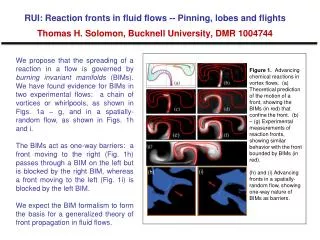
RUI: Reaction fronts in fluid flows -- Pinning, lobes and flights Thomas H. Solomon, Bucknell University, DMR 1004744 We propose that the spreading of a reaction in a flow is governed by burning invariant manifolds (BIMs). We have found evidence for BIMs in two experimental flows: a chain of vortices or whirlpools, as shown in Figs. 1a – g, and in a spatially-random flow, as shown in Figs. 1h and i. The BIMs act as one-way barriers: a front moving to the right (Fig. 1h) passes through a BIM on the left but is blocked by the right BIM, whereas a front moving to the left (Fig. 1i) is blocked by the left BIM. We expect the BIM formalism to form the basis for a generalized theory of front propagation in fluid flows. Figure 1. Advancing chemical reactions in vortex flows. (a) Theoretical prediction of the motion of a front, showing the BIMs (in red) that confine the front. (b) – (g) Experimental measurements of reaction fronts, showing similar behavior with the front bounded by BIMs (in red). (h) and (i) Advancing fronts in a spatially-random flow, showing one-way nature of BIMs as barriers. (i) (h)
RUI: Reaction fronts in fluid flows -- Pinning, lobes and flights Thomas H. Solomon, Bucknell University, DMR 1004744 Reactions are prevalent in nature and in technological applications. In addition to chemical reactions, biological systems often involve a reaction-like front; e.g., the spreading of a disease, the growth of a population of animals or plant-life, and various flow-enhanced processes in developing embryos. The behavior of reaction fronts in flows may also play a significant role in developing nuclear fusion as an efficient energy source. Our studies all involve undergraduate students, who play a significant role in all aspects of the research, including planning of the experiments, construction and testing of the apparatus, data collection and analysis, publication of the results, and presentation at national conferences. The students supported by this grant interact with others in our department’s REU program. Picture of REU students and mentors from 2011 program, along with Dylan Bargteil (second from left in front row) who was funded by this NSF grant.