Enhancing VoIP Communications: Service Providers and Key Requirements
This document outlines essential requirements and service levels for Voice over IP (VoIP) within networks. It covers SIP (Session Initiation Protocol) for enhanced communications, including video and chat via SIMPLE and XMPP protocols. Key considerations encompass presence and location services, web-based collaboration tools, identity authentication, financial implications, security concerns, and roaming features. Additionally, the roles of various service providers—network, transport, session, application, and advisory—are defined to ensure efficient integration and functionality within Next Generation Networks (NRNs).

Enhancing VoIP Communications: Service Providers and Key Requirements
E N D
Presentation Transcript
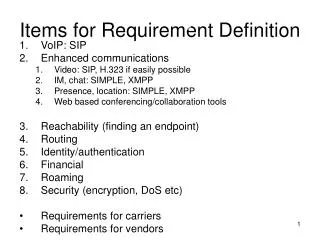
Items for Requirement Definition 4 • VoIP: SIP • Enhanced communications • Video: SIP, H.323 if easily possible • IM, chat: SIMPLE, XMPP • Presence, location: SIMPLE, XMPP • Web based conferencing/collaboration tools • Reachability (finding an endpoint) • Routing • Identity/authentication • Financial • Roaming • Security (encryption, DoS etc) • Requirements for carriers • Requirements for vendors
5 levels of activity of an NRN regarding VoIP 4 • Network Service provider (bits, lightpath) between carrier and institution • Transport Service provider (IP packets, VPN) between carrier and institution • Session Service provider (SIP) • Application Service provider (end-user service) • Advisory role
Routing options (FCCN) 4 • VoIP inside NRN • Private numbering plan • Public numbering plan • PSTN gateways • Central service by NRN • Distributed by institutions • Local • ‘roaming’ • Interconnect to NRN’s (peering, FW, SBC, proxy) • Internet SIP domains
Quick overview of VoIP status at NRN’s: 4 I CH N PT CZ NL GR NetSP Y TransSP II, CI ‘07 ‘07 ‘07 ‘07 II, CI II SessSP ‘07 II, CI II AppSP ‘07 Y(3) Y(3) Y Advice Y Y Y Y Y Y Y Nrplan pub pub pub pub pub pub pub GWs L ’07 L L ‘07 L,C L • Inter-institution or Carrier-Institution • Only for non-PSTN • Test bed • Central, Local (at institution)