Understanding Thermodynamic Functions: Internal Energy, Enthalpy, Entropy, and Free Energy
60 likes | 182 Vues
This resource delves into the foundational concepts of thermodynamic functions in chemistry, focusing on internal energy (U), enthalpy (H), entropy (S), and free energy (G) as functions of temperature. Key principles such as the behavior of these functions at absolute zero and their variations at non-zero temperatures are explored. The text also covers contributions of heat, both at constant volume and pressure, and the implications of the third law of thermodynamics. This material is essential for anyone studying thermochemistry and statistical thermodynamics.


Understanding Thermodynamic Functions: Internal Energy, Enthalpy, Entropy, and Free Energy
E N D
Presentation Transcript
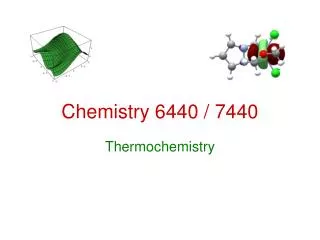
Chemistry 6440 / 7440 Thermochemistry
Resources • McQuarrie, Statistical Thermodynamics, University Science Books, 1973 • Foresman and Frisch, Exploring Chemistry with Electronic Structure Methods, Chapter 4 • Cramer, Chapter 10 • Jensen, Chapter 12 • www.gaussian.com/thermo.html
Thermodynamic Functions • U(T) - internal energy at absolute temperature T • H(T) = U(T) + PV = U(T) + RT - enthalpy • S(T) - entropy • G(T) = H(T) – T S(T) – free energy
Thermodynamic Functions • at absolute zero, T = 0 U(0) = H(0) = G(0) U(0) = electronic energy + zero point energy S(0) = 0 for a pure crystalline substance (third law of thermodynamics)
Thermodynamic Functions at T 0 • U(T) = U(0) + CvdT • heat at constant volume, molecule gains energy for translation (3/2 RT), rotation (3/2 RT) and vibration ( 1/(1-exp(-i/kT)) • H(T) = H(0) + CpdT • heat at constant pressure, molecule gains additional energy from expansion • S(T) > 0 • more states become accessible as the temperature increases