Download
1 / 8
90 likes | 231 Vues
The quantum model of the atom revolutionized our understanding of electrons, suggesting they possess dual wave-particle nature as proposed by Louis de Broglie. This model highlights wave properties such as diffraction and interference, alongside Heisenberg's uncertainty principle, which states it’s impossible to know an electron's exact position and velocity simultaneously. Schrödinger's wave equation describes the probability of an electron's location in orbitals defined by quantum numbers, which detail electron properties, energy levels, orbital shapes, and orientations, leading to a comprehensive understanding of atomic structure.

E N D
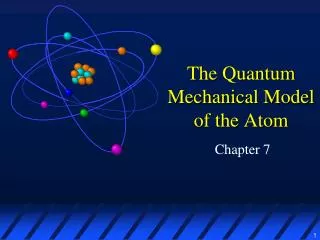
Light and Electrons • Louis de Broglie suggested that e- in fixed orbitals (like Bohr suggested) behave with wave like properties. • He hypothesized that electrons also have dual particle-wave nature.
Electrons as waves • Can be diffracted – wave passes by the edge or through a small opening • Interference – waves pass over each other • Heisenberg uncertainty principle – it is impossible to determine simultaneously both the position and velocity of an e- or any other particle.
Schrödinger • Schrödinger wave equation – probability of finding an electron in a certain orbital • Schrö and Heis = foundation for … • Quantum Theory – describes mathematically the wave properties of electrons and other very small particles.
Quantum Numbers • Orbital – 3-d region around the nucleus that indicates the probable local of an e- • We can learn more than just what orbital e-s are in… • Quantum Numbers – specify the properties of atomic orbitals and the properties of e- in orbitals • Like seats at a concert
Principal Quantum Number, n • PQN–the main E level occupied by the e- • n values are positive • As n increases so does the distance from the nucleus • Angular momentum quantum number, l – the shape of the orbital • Values can be 0 and any # lower than what n = (if n=3, l can be 0, 1, and 2)
Magnetic Quantum Number, m • MQN = the orientation of the orbital around the nucleus • Values can be whole numbers, from -l, 0 to +l • If l = 2, m can be -2, -1, 0, 1, 2
The Spin Quantum Number • SQN = has only 2 possible values (+1/2, -1/2) which indicate the two fundamental spin states of an electron in an orbital • A single orbital can hold a max of 2 electrons, but they must have opposite spin states.