Optimizing Telescope Image Quality through Wavefront Error Correction and Simulation Analysis
This study explores the impact of mirror figures, rigid body positions, and atmospheric conditions on the image quality of telescopes. Utilizing a wavefront sensor estimator and simulation architecture, the analysis examines temperature variations, camera rotation, and thermal gradients. By employing look-up table corrections in ZEMAX models, we can quantify wavefront errors and improve image sharpness characterized by RMS and FWHM metrics. The work emphasizes the correlation between controlled and uncontrolled variables affecting wavefront quality during observations.

Optimizing Telescope Image Quality through Wavefront Error Correction and Simulation Analysis
E N D
Presentation Transcript
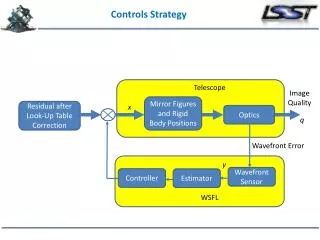
Controls Strategy Telescope Image Quality x q Mirror Figures and Rigid Body Positions Residual after Look-Up Table Correction Optics y Wavefront Error Wavefront Sensor Estimator Controller WSFL
Simulation Architecture Temperature, elevation, camera rotation, thermal gradients Atmosphere* Image Quality (RMS FWHM) x2 x q Mirror Figures and Rigid Body Positions Look-Up Table, Laser Tracker ZEMAX Model Wavefront Images y Wavefront Sensor Estimator x: controlled variables x2: uncontrolled variables * Atmosphere is assumed to be uncorrelated between exposures Controller
Simulation Architecture Temperature, Elevation, Camera Rotation, Thermal Gradients, Laser Tracker accuracy Atmosphere* Camera Internal Optics x2 Image Quality x q Telescope Mirror Figures and Rigid Body Positions Residual after Look-Up Table Correction ZEMAX Model y Wavefront Sensor Estimator Wavefront Error WSFL x: controlled variables x2: uncontrolled variables, including high order mirror figure errors and camera internal distortions * Atmosphere is assumed to be uncorrelated between exposures Controller