Network Coding Testbed
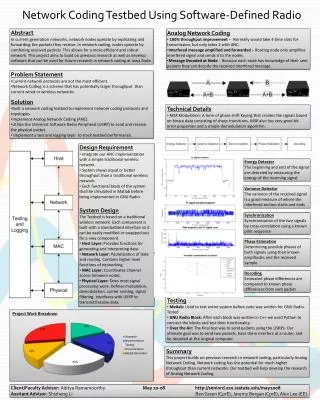
This project aims to implement Analog Network Coding (ANC) in wireless networks using GNU Radio and USRP. The goal is to increase network throughput by intelligently combining packets at intermediate nodes. The project includes designing a generalized MAC for arbitrary topologies and implementing a testing framework while considering constraints like USRP usage and processing power. The system design involves the host, network, MAC, and physical layers, with testing and logging for validation. It also covers ANC implementation for decoding interfered signals and explores ANC topologies like Alice-Bob and chain structures. The project methodology includes Matlab simulations, GNU Radio implementation, and air testing to compare simulation results. Questions are welcome regarding the schedule and progress.

Network Coding Testbed
E N D
Presentation Transcript
Network Coding Testbed Jeremy Bergan, Ben Green, Alex Lee
Presentation Overview • Background Information • Project Overview • Framework Design • Progress and Plan
Network Coding • Intelligently combining packets at intermediate nodes to increase network throughput Network Coding Overview
ANC: Decoding Interfered Signals • Node1 and Node2 simultaneously transmit • Signals interfere at intermediate node • Intermediate node amplifies and forwards combined signal • Node1 can decode Node2's message based on knowledge of the message it sent previously Sachin Katti, Shyamnath Gollakota, Dina Kattabi, Embracing wireless interference: Analog Network Coding, in ACM SIGCOMM Computer Communication Review v.37, n.4, pp 397 – 408, October 2007
Project Overview • Wireless Network Testing Framework • Use this Framework to implement and test Analog Network Coding • Implement generalized MAC for arbitrary topologies • GNU Radio • Mature Signal Processing Libraries • Universal Software Radio Peripheral (USRP)
Requirements • Implement a testing framework for wireless networks • Implement a Network coding scheme with equal or better throughput than traditional networks • Implement ANC MAC • Practical application to arbitrary network topologies • Use of Universal Software Radio Peripheral (USRP) • Use of GNU Radio signal processing libraries • Modular design
Constraints • USRP • Number of nodes • Frequency Range • Bandwidth • Transmission Power • Processing • CPU Cycles • Time
Assumptions • Tested under reasonable conditions • Normal level of background noise • Global knowledge of routing at each node • Routing patterns will be pre-generated • Routing protocols outside scope of this project
Resources • 14 USRPs • All with daughter-boards able to transmit and receive between 2.4 - 2.5 GHz • 5 Dell Optiplex Computers • 3 With the Ubuntu Operating System • 2 With Red Hat Linux Operating System • Various Daughter Boards • Transmitters with different frequency range • Receivers with different frequency range • Transceivers
Functional Decomposition • Prototype in Matlab • Test in Matlab Design Process
System Design Host: Generates and interprets data Network: Packetizes and determines data route MAC: Arbitrates channel access. Coordinates transmission among nodes Physical: Modulation/Demodulation Testing and Logging: Tools used in testing of system
Physical Layer • Modulation / Demodulation • Transmission / Reception • Carrier Sense • All signal processing functions
MAC Layer • Coordinate channel access between nodes Network Layer • Packetization of data • Routing Path is predetermined for each packet • Packet scheduling
Host Layer • Generates data to send • Receives and processes data • Several possible data types • Random data • Pre-determined pattern • Streaming media (audio/video) • Kernel network interface
Testing and Logging Layer • Select logging/testing options • Logging data to file from individual layers/components • Scopes/Visualization of data from individual layers/components • Generation of statistics • Validation
Basic Network Implementation • Physical Layer • QPSK modulation • MSK modulation • MAC Layer • Simplified IEEE 802.11 MAC (CSMA/CA) • Network Layer • Predetermined routing • Similar packet format as 802.11 • Host Layer • Random data • Predetermined patterns of data
Analog Network Coding Implementation • Physical Layer • MSK modulation • ANC algorithm for decoding interfered signals • MAC Layer • Modified CSMA/CA • Allows for simultaneous interfering transmissions if they will be able to be correctly decoded • Network Layer • Same as Basic network • Host Layer • Same as Basic network
ANC Topologies • Alice - Bob • Chain • X
ANC: Generalized MAC • Design a MAC that allows simultaneous transmissions when both interfered messages can be decoded • Generalized algorithm that works for multiple topologies • Distributed Algorithm • Similar to 802.11 DCF • Nodes send information about packets in buffer • Use RTS and CTS messages to coordinate interfering transmissions
Implement each component of the design in Matlab • Simulation in a controlled environment • Implement each component with GNU Radio and USRP • Compare each component with simulation results • Test framework over air Testing Procedure
Matlab Simulations • Prototyping in Matlab has started • QPSK Simulation • Transmission and Reception • Currently working on a full ANC implementation • MSK Modulation and Demodulation