Download
1 / 12
120 likes | 247 Vues
This overview explains the relationship between work and energy transfer, defining work as the force used to move an object. It introduces the Joule, the standard unit of work, and distinguishes between kinetic energy (energy of motion) and potential energy (stored energy). It also covers mechanical energy, defined as the sum of potential and kinetic energy, and elaborates on the conservation of energy principle. Additional energy forms such as thermal, chemical, nuclear, and electromagnetic energy are briefly discussed, emphasizing how energy can be transferred and transformed across different forms.

E N D
4.2 Energy is transferred when work is done. Tami Torres 2011
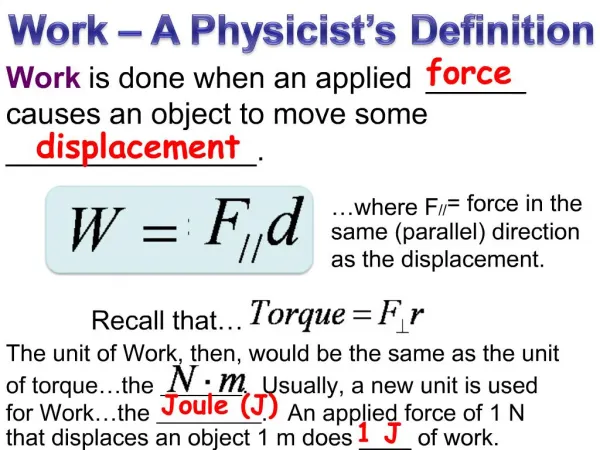
Some Helpful Definitions • Work ~ the use of force to move an object some distance. • Joule (jool) ~ the standard unit of measure for work. One joule of work is done when a force of one Newton moves an object one meter.
Work Transfers Energy • Energy ~ the ability of a person or an object to do work or to cause a change. • When you do work on an object, some of your energy is transferred to the object. • Think of work as the transfer of energy.
Kinetic Energy ~ the energy of motion. • Any moving object has kinetic energy. The faster it moves, the more kinetic energy it has. • Potential Energy ~ stored energy or energy due to its position or its shape. • A ball held in your hand above the ground has the potential to fall to the ground.
Mechanical Energy ~ the energy possessed by an object due to its motion or position. In other words, the combined potential and kinetic energy of an object. ME = PE + KE
Conservation of Energy ~ No matter how energy is transferred or transformed, all of the energy is still present somewhere in one form or another.
Conserving Mechanical Energy • At the top, a roller coaster has potential energy because gravity can pull it downward. There is no velocity so there is no kinetic energy. • As the roller coaster goes downhill, the potential energy decreases because the elevation decreases. The kinetic energy increases because the velocity increases. • At the bottom, all of the energy is kinetic because gravity cannot pull the roller coaster down any further. • The mechanical energy remains the same at all times.
Other Forms of Energy • Thermal Energy ~ the energy an object has due to the motion of its molecules. • Chemical Energy ~ the energy stored in chemical bonds that hold chemical compounds together.
Other Forms of Energy • Nuclear Energy ~ the potential energy stored in the nucleus of an atom. • Electromagnetic Energy ~ the energy associated with electrical and magnetic interactions. • It is possible to transfer, or convert, one energy form into one or more other forms.