Overview of Extended Interaction Klystron for CloudSat Applications
This document provides an in-depth overview of the High-Powered Amplifier (HPA) based on Extended Interaction Klystron (EIK) technology, specifically designed for CloudSat applications. It discusses the system's components, including exciters, receivers, oscillators, and calibration methods. Key specifications such as modulation requirements, pulse rates, and power considerations are outlined. Additionally, the document addresses the challenges and options in selecting an appropriate modulator, highlighting the need for effective engineering support and cooling solutions for optimal performance.

Overview of Extended Interaction Klystron for CloudSat Applications
E N D
Presentation Transcript
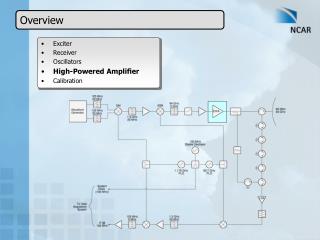
Overview • Exciter • Receiver • Oscillators • High-Powered Amplifier • Calibration
HPA: Extended Interaction Klystron • EIK-based amplifier appears to be the best suited • Conduction cooled unit was developed for CloudSat • Mounted in a pressure vessel in the pod with modulator and RF front-end electronics EIK Specifications CloudSat Flight Model EIK
HPA: Modulator • Requirements • 5 % duty cycle • Up to 20 kHz pulse repetition rate • Pulse lengths from 200 ns to 2 µs • Aircraft ready (vibration, attitude changes) • Options • Communications & Power Industries (CPI) • Expensive modulator • Reports of bad experiences • Pulse Systems • Cheap • Largely untested • Applied Systems Engineering (ASE) • Very expensive • Good engineering support • Looking for advice and comments
HPA: Waveguide • Peak Power Considerations • WR-10 can handle around 8 % (1.34 kW at 94 GHz) of the waveguide theoretical peak power (Ciavolella, 1972) • Pressurize the front-end electronics waveguide with nitrogen • Average Power Considerations • Maximum rated average power of WR-10 is 18 W at 94 GHz • At 1 µs pulse length and a 10 kHz PRF, the average power out of the EIK is 17 W assuming no standing waves in the waveguide • May need to use heat-sinks and forced-air cooling to remove heat from the waveguide walls