Understanding Resistor Connections: Series, Parallel, Delta, and Wye Configurations
90 likes | 216 Vues
This guide provides a comprehensive overview of resistor configurations in electrical circuits, specifically focusing on series and parallel connections, as well as Delta (Δ) and Wye (Y) connections. Learn how to identify which resistors are in series or parallel, and explore the intricacies of Delta to Wye conversions and vice versa. Key principles are illustrated with algebraic manipulations ensuring the resistance between terminal pairs remains consistent. Essential for understanding Circuit Theory I (ECE 201), this resource serves as a valuable tool for students and professionals alike.


Understanding Resistor Connections: Series, Parallel, Delta, and Wye Configurations
E N D
Presentation Transcript
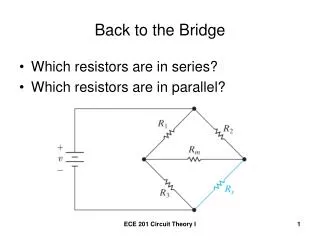
Back to the Bridge • Which resistors are in series? • Which resistors are in parallel? ECE 201 Circuit Theory I
Delta (Δ) Connection • Resistors R1, R2, and Rm (or R3, Rm, and Rx) are in a Delta (Δ), or pi (π) connection. ECE 201 Circuit Theory I
Wye (Y) Connection • Resistors R1, Rm, and R3 (or R2, Rm, and Rx) are in a wye (Y), or tee (T) connection. ECE 201 Circuit Theory I
Δ – Y Conversion ECE 201 Circuit Theory I
Δ – Y Conversion (continued) • The resistance between the terminal pairs must be the same for both circuits ECE 201 Circuit Theory I
Δ – Y Conversion (continued) • After some algebraic manipulation ECE 201 Circuit Theory I
Y – Δ Conversion ECE 201 Circuit Theory I
Y – Δ Conversion (continued) • The resistance between the terminal pairs must be the same for both circuits ECE 201 Circuit Theory I
Y – Δ Conversion (continued) • After some algebraic manipulation ECE 201 Circuit Theory I