Amazing Arachnids!
"Amazing Arachnids" by Ruth W. Rose is an engaging curricular unit designed for students in grades 3-4. This resource distinguishes arachnids from insects, highlighting their unique characteristics, adaptations, and ecological roles. Students will learn that arachnids, such as spiders and ticks, have eight legs and two body parts. The unit includes fun poems about arachnids, encouraging creativity while reinforcing scientific concepts. Interactive activities will help students understand the importance of arachnids in our environment and their differences from insects.
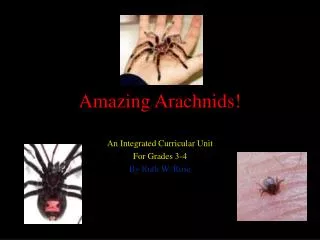

Amazing Arachnids!
E N D
Presentation Transcript
Amazing Arachnids! An Integrated Curricular Unit For Grades 3-4 By Ruth W. Rose
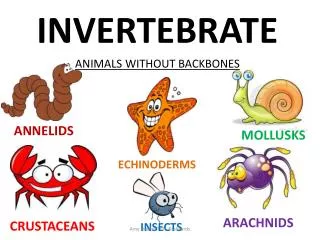
Arachnids are amazing, but they are NOT insects! • Many people talk about “BUGS,” but that’s not a scientific term. • What they really mean is: • Insect or • Arachnid
Some examples of Arachnids are: • Ticks • Scorpions • Tarantulas • Mites • Spiders • Arachnids are an ancient group of animals, dating back 400 million years!!!
Some examples of insects are: • Ants • Bees • Houseflies • Butterflies • Beetles • Wasps • Preying Mantis • Grasshoppers
Arachnids and Insects both belong to the Arthropod family. • They have similarities, but they also have differences… • Arachnids have 8 legs • Insects have 6 legs • Arachnids have 2 main body parts: • Cephalothorax and abdomen • Insects have 3 main body parts: • Head, thorax and abdomen
HelpfulArachnids… • Arachnids can be helpful! • Spiders help to control the insect population by catching insects in their webs as their prey.
Harmful Arachnids • Bites from the Black Widow Spider and the Brazilian Wandering Spider can be deadly if not treated. • Ticks can carry blood-borne diseases such as Lyme Disease.
Arachnids have made adaptations to live in their environment. • Some spiders catch food (prey) in their webs. Usually their prey is a type of insect. • Wolf Spiders are very large and they live in the tropical rain forest. They don’t spin webs. They jump on their prey to catch it.
More adaptions… • Some arachnids use their camouflage colors to hide in their environment. • Crab Spiders hide inside flowers, waiting to pounce on visiting insects. • Long-Jawed Spiders blend in with the grass. They lay in wait for their prey to walk past.
Now that you know the difference between Arachnids and Insects… • The next time you see a SPIDER in a web, what group of small animals is it part of? • What would you call the HOUSEFLY that the spider caught in its web? • If the SPIDER eats the FLY, what’s a scientific name for that snack?
If you answered… • The SPIDER is an ARACHNID • The HOUSEFLY is an INSECT • The SPIDER’S snack is its PREY……. • ……………YOU’RE CORRECT!!!
Just for fun…Arachnid PoemsWhat am I? • I am a widow— • I always wear black, • From my eight dainty legs • To my shiny round back. • Do not disturb me. • My fans carry venom. • I am a widow— • I don’t wear blue denim.
What am I? • A Black Widow Spider!
Another Arachnid Poem…What am I? • Not gigan-tic • Not roman-tic • Not artis-tic • Not majes-tic • Not magne-tic • Nor aesthe-tic • ______are strictly parasi-tic.
What is this parasitic arachnid? • A Tick!
Insectlopedia • These poems were written by Douglas Florian. Many more poems about arachnids and insects can be found in his book, entitled: • INSECTLOPEDIA
To find more information on arachnids and insects, visit these Internet sites: • http://www.spiderroom.info/webdesigns.html • http://www.bbc.co.uk/nature/reallywild/features/cc_index.shtml • http://magma.nationalgeographic.com/ngexplorer/0310/quickflicks/index.html • http://www.urbanext.uiuc.edu/insects/01.html • http://www.brooklynexpedition.org/structures/bugs/buildabug/buildabug.htm
That’s all, Folks! • For now . . . • But you’ll probably want to find out more on your own!!!