Implementing IFRS for Global Financial Reporting
Explore the challenges and benefits of adopting International Financial Reporting Standards (IFRS) for global homogenous information. Learn about the impact on cross-border listings, accounting practices, and international business operations. Delve into the role of national standards bodies, adoption costs, and the need for uniformity in financial reporting.

Implementing IFRS for Global Financial Reporting
E N D
Presentation Transcript
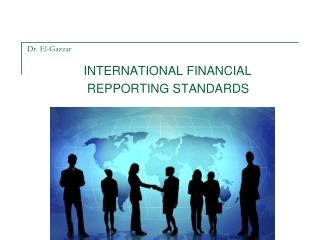
Dr. El-Gazzar INTERNATIONAL FINANCIAL REPPORTING STANDARDS
International Financial Reporting Standards (IFRS): The Necessary Conditions for Globally Homogenous Information Samir M. El-Gazzar, PhD KPMG Professor of Accounting Lubin School of Business Pace University, USA
Emerging Need for International Accounting Standards • International Business Operations • Cross-Boarder Listings of Securities A. International Business Operations ► Foreign Operations: Buy or Sell (from and to foreign entities) ▼ - Translation into National Currency - Hedging for Currency Fluctuations ► Foreign Division ▼ Consolidation Accounting
Emerging Needs…………… • Cross-Boarder Listings of Securities ▼ ● Costs and Benefits Benefits: - Access to Capital Markets Guest company’s ability to raise capital in foreign markets, probably at lower cost of capital - Local Investors: Expanded opportunity for investing in foreign companies, leading to better allocation of resources Costs - Host Country Investors’ Information Risk - Guest Company’s Cost of Complying with Foreign Laws
Approaches for Solving the Financial Reporting Problems • Company Issues One Set of Financial Statements to All Users: the market is efficient in converting and evaluating reporting differences (e.g., HKSE). • Reconciliation to Host Country Reporting Standards (e.g., USSEs prior to 2007). • Two Sets of FS: one for the local market and one for the foreign market. • Develop and Adopt World-Wide reporting system (IFRS). Most likely. But:
QUIZAssume these countries adopted IFRS. • China France India USA KSA • EPS $ 3.00 3.00 3.00 3.00 3.00 • Do these numbers convey the same information content/ risk? • Yes What No Not Sure
Uniform Accounting Rules Don't Guarantee Same Quality Information • Accounting Information is an output of a system that is influenced by many indigenous and exogenous drivers: ► Accounting Recognition and Measurement Standards (e.g., IFRS) ► Preparer’s Education and Competencies ► Attester’s Qualifications and Licensing ► Presence and Level of Governance ► Legal Enforcement of Rules ► Economic System and Information Needs ► Cultural and Local Values
Preparer’s Education and Competencies ►Curriculum: Broad knowledge versus Specialization. Economics, sociology, psychology, financial markets, languages, and Accounting. International Accounting Education Standards Board: (e.g., IES No. 8: Competencies for Audit Professionals. ►Mode of Teaching: Case Study with interdisciplinary Approach: - Financial Acc Augmented with Corporate Finance and Capital Markets. - Managerial/Cost Acc augmented with Chain Supply or Production Management.
Attester’s Qualifications and Licensing • USA ► 150 Credits and National (CPA) • Exam. • UK ► Exams and Focus is on Training • Turkey ► 3-Levels of Accountants: a. Independent Accountant. b. Certified Public Accountant c. Sworn-in CPA • China ► ……. ?!
Enforcement and National Sovereignty • Monitoring Execution, Performance and Behavior of IFRS, Auditing, Educational, and Governance Standards. • In Cases of Conflict and Litigation: Who is in charge? National Authorities or International Board of Governors (IBG). ▼ Member Countries must respect the Decisions of the IBG. Is that Feasible?
National Information Needs • Different Countries Require Their National Firms and Foreign Subsidiaries to Provide Certain types of information necessary for: - National Planning and Investment Policy - Tax Incentives/ Structure and Regulation - Employment Opportunities - Social Accountability Annual Report ▼ ▼ IFRS National Needs
Additional Concerns • Principles Based Standards and Litigation • Role of Existing National Standard Setting Bodies • Adoption Costs and Small Firms • Reciprocal Treatment • Uniformity works against Innovation and Advancement.
Principles Based Standards and Litigation IFRS National Standards ▼▼ Principles Based Rules Bases Emphasis ● Economic Substance ● Satisfying the Steps ● More Judgment ● Less Judgment Litigation ● Easy to prove not guilty ● Hard to prove not guilty (Donelson et al., 2009)
Role of National Standard Setting Bodies I : Eliminate: Redundant / No Need II : Liaison with IASB: - Enforcement Agency - Advisory for Emerging Local Issues III : Some New Function ?!
Adoption Costs ● System Change Costs.. Redesign the accounting and information system to impound IFRS standards. ● Training Existing Accountants and other information personnel… in house training and education…more formal back school programs. Solution: IFRS for Small and Medium size companies. ► Against the comparability objective of IFRS. ► Discriminates in resource allocation.
Reciprocal Treatment • Professional Accountants from small countries.. Dominance by large firms, e.g., Big-4 • Dominance of the IAS Committee Foundation by Large countries..... Another UN veto…….
CONCLUTION • GLOBAL ADOPTION OF IFRS IS A NECESSARY CONDITION BUT INSUFFIENT FOR PRODUCING Globally Comparable / Homogeneous Accounting Information.
QUESTIONS THANK YOU
Appoints KEY: New Structure Reports To Advises IASC Foundation 19 Trustees Appoint, Oversee, Raise Funds Board: 12 Full time & 2 Part Time Set Technical Agenda Approve Standards, Exposure Drafts, & Interpretations Standards Advisory Council49 members International Financial Reporting Interpretations Committee (12 members) Advisory GroupsFor Major Agenda Projects