Download
1 / 7
90 likes | 235 Vues
In this second part of our series on persuasion, we dive into the three types of arguments: Ethos, Logos, and Pathos. Ethos focuses on establishing the writer's credibility through scholarly sources and logical reasoning, minimizing emotional appeals. Logos emphasizes the use of facts and logical connections to refute counterarguments, avoiding fallacies. Lastly, Pathos involves appealing to the audience's emotions but should be used sparingly and primarily to reinforce your conclusion. Learn how to construct strong, convincing arguments in your academic writing.

E N D
Persuasion Getting people to agree with you Part II: Types of Arguments
Subject Audience Text CONTEXT LOGOS: Facts about the subject/situation ETHOS: Character of the writer PATHOS: Emotions of the audience Writer
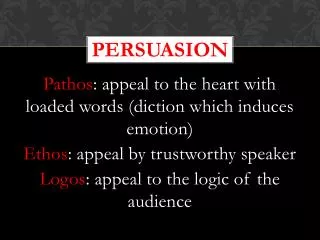
Ethos: character of the writer • Should not be a major issue in this kind of paper • Establish your credibility by showing that you know your material: • Use appropriate (scholarly) sources • Use appropriate language/conventions • Draw reasonable conclusions • Avoid name-calling and other unseemly tactics • Avoid too many emotional appeals
Logos: facts about the subject/situation • Should be the major strategy for academic papers • Present the facts and connect the dots • Use lots of evidence, and from different sources • Use logic, not emotion, to refute opposing arguments • Avoid “straw men” and other fallacies • Show how opposing arguments aren’t logical OR aren’t practical OR aren’t as good as your arguments
Pathos: emotions of the audience • Use only sparingly in academic papers • Appeal to values such as honesty, integrity, & fairness • Generally most effective for closing arguments
Intro: Announce the topic and the issues; state common ground. ETHOS Establish your credibility with clear, concise, dispassionate explanations. Argue against your position. Make the case for the other side, then use “but” to show potential problems with those arguments. LOGOS Argue for your position. Offer alternative arguments, showing how they are preferable to, or at least less undesirable than, the initial ideas. LOGOS Remind the reader of your common ground, and show how your position offers the better path to that ground. PATHOS Here’s where you can use a little pathos, if necessary, to “close the deal.”