Download
1 / 12
180 likes | 413 Vues
Learn about septage, its composition, and new guidelines for managing it in South Australia. Find out the latest requirements and responsibilities for waste transporters and landowners. Follow proper disposal practices to protect the environment.

E N D
South Australia’s Environment Protection AuthorityCommunity Wastewater Management SystemsFriday 23rd August 2019
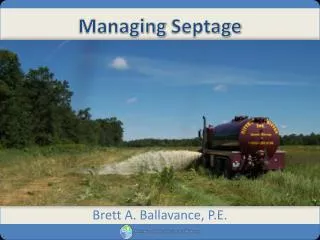
What is septage? • The product of periodic desludging of a septic tank • Primarily septic tank sludge (semi-solid), but may include septic tank effluent (liquid) mixed in when desludging a septic tank
What is found in septage? • Scum – floating fats, oil and grease and any solid waste • Septic tank sludge – solids collect at the bottom of the tank and where most of the bacteria involved in the breakdown of biodegradable material in the absence of oxygen • Nutrients – Nitrogen, ammonium, phosphorus, potassium, sodium
What’s in the new guideline? • Updated terminology • Clarification of Land-owner and Waste Transporter mandatory obligations • Reflects changes to Schedule 1 of the Environment Protection Act 1993 • Will link with new conditions for Waste Transporters
Waste management hierarchy • Management of septage must be consistent with the waste management hierarchy Most Preferable AVOID REDUCE REUSE RECYCLE RECOVER TREAT DISPOSE Least Preferable
Septage uses *Councils should ensure that this is reflected in any contracting arrangements *Similar requirements for wastewater treatment plant sludge Most Preferable AVOID REDUCE REUSE RECYCLE RECOVER TREAT DISPOSE Least Preferable { Where reasonably practicable, septage must be taken to a facility licensed to receive septage(Treat, Recover, Recycle, Reuse) Septage may be used as a soil conditioner (excluding horticulture for food production) only if for beneficial reuse in accordance with EPA guidelines (Dispose, Reuse)
New EPA requirements • Licensed Waste Transporters • Desludging of septic tanks and transporting that waste for fee or reward requires an EPA licence • Land-owners • The disposal of human wastewater or sewage to land in a manner approved by the Authority is a ‘prescribed approved activity’ that does not require a licence • Record keeping (compulsory for Licensed Waste Transporters)
Septage “musts” • Take septage to a licensed facility, where reasonably practicable • Apply to land only if for beneficial reuse (i.e. in accordance with guideline) • Keep sludge from commercial or industrial sources separate • Confirm consent between licensed Waste Transporter and Land-owner • Fence to prevent access by the public • Follow Land Selection Criteria and Septage Application (in guideline) and “must nots”… • Do not apply septage to land • where it may enter waters, or pool, water log or runoff • used for horticulture for food production or home gardens • causing off-site odour impacts • within 400 m of any dwelling on neighbouring properties
Application rate • Septagemust not be applied to land at a rate greater than 128 kL per hectare for each application Mark or peg applications
EPA Guidelines and Documents Available online: www.epa.sa.gov.au 8204 2004 Also call for incident reporting S.83(1) of the Act: Must notify of an incident causing or threatening environmental harm. Must notify of site contamination of underground water. Offence to contravene this section of the Act.