Download

1 / 9
90 likes | 204 Vues
This guide provides a comprehensive overview of the Chain Rule, a fundamental theorem in calculus that allows for the differentiation of composite functions. It states that if y = f(u) is differentiable and u = g(x) is also differentiable, then y = f(g(x)) is differentiable with the derivative dy/dx = (dy/du)(du/dx). The text includes step-by-step examples on how to apply the Chain Rule in different situations, discusses higher-order derivatives, and provides key theorems related to trigonometric functions and logarithms for a well-rounded understanding.

E N D
Topic 8The Chain Rule By: Kelley Borgard Block 4A
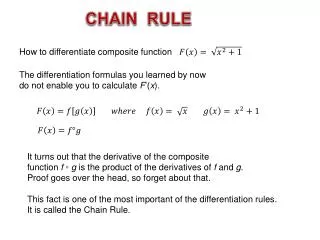
Theorem 2.10 • If y = f(u) is a differentiable function of u, and u = g(x) is a differentiable function of x, then y= f(g(x)) is a differentiable function of x and: dy/dx= dy/du du/dx Or d/dx [f(g(x))] =f’(g(x))g’(x)
Example • f(x) = 3(x2 + 2)3 Step 1: Substitute an “x” for (x2 + 2) and take derivative. f(x) = 3(x)3 f’(x)= 9(x)2 Step 2: Replace the original values inside the parentheses. f’(x) = 9(x2+2)2 Step 3: Take the derivative of the values inside the parentheses and multiply the result by the first derivative taken. x2 + 2 f’(x) = 2x f’(x) = 9(x2 +2)2 2x =18x(x2 = 2)2
Try This f(x) = 4(x2 +1)3 f(x) = 4(x)3 (substitute x) f’(x)= 12(x)2 f’(x) = 12(x2+1)2 (replace with original values) f(x) = x2 +1 → f’(x) = 2x (take derivative of values inside the parentheses) f’(x) = 12(x2 +1)2 (2x) (multiply together) f’(x) = 24x (x2 +1)2
Example 1 f(x) = √(2x2 +4) = (2x2 +4)1/2 f’(x) = ½ (2x2+4)-1/2 (4x) = 2x/(2x2+4)1/2 Example 2 f(x) = 2/(x+3)3 = 2(x+3)-3 f’(x) = -6(x+3)-4 (1) = -6/(x+3)4 More Examples
Example • Find the 1st, 2nd, 3rd, and 4th derivatives. Then Find all the derivatives up through 100. f(x)=4x3 f’(x)=12x2 f’’(x)=24x f’’’(x)=24 f (4)(x)=0 f(5)(x)=0 f(5)(x)=f(6)(x)=…=f(100)(x)=0
Theorems 2.6 and 2.9 • 2.6: Derivatives of Sine and Cosine Functions • d/dx [sin x] = cos x • d/dx [cos x] = -sin x • 2.9: Derivatives of Trigonometric Functions • d/dx [tan x] = sec2x • d/dx [sec x] = sec x tan x • d/dx [cot x] = -csc2x • d/dx [csc x] = -csc x cot x
Natural Log • Ln (1) = 0 • Ln (ab) = Ln(a) + Ln(b) • Ln (an) = nLna • Ln (a/b) = Lna – Lnb *a and b are positive and n is rational