
Independence Movements
E N D
Presentation Transcript
Independence Movements India! Middle East! Africa! Latin America!
Striving for Independence: India, Africa, and Latin America, 1900-49
Indian Independence, 1905-1947 • The Land and the People • Classes and Languages – growth created pressures, less land • Peasants (majority) – over taxed, Maharajahs (ruling princes) – protected • English = common language of western educated • Religion – Hindu center with Muslim sides
Indian Independence, 1905-1947 • British Rule and Indian Nationalism • Viceroy & Indian Civil Service • Indian National Congress – founded in 1885 • 1905 – British divide Bengal Province in two, putting Hindu at disadvantage in east • 1906 – All-India Muslim League – Muhammad Ali Jinnah • 1911 – Brits moved capital – Calcutta to Delhi (Mughal capital) = wake-up call • Indian Steel Industry – symbolic hope for independence • WWI left promises of self-rule, upon return, outbreaks of violence • 1919 – Rowlatt Act = denial of habeas corpus, no public protests allowed • 1919 – Amritsar Massacre – Brits open fire on peaceful protestors killing 1,200
The Indian Independence movement, 1905-1947 • Mahatma Gandhi and Militant Nonviolence • Mahatma = Great Soul, western educated lawyer, cut his teeth in South Africa • Ahimsa (nonviolence) + Satyagraha (search for the truth) = nonviolent civil disobedience • Wore homespun, brought independence ideas to the peasant (majority) • Salt March to protest British tax on salt • When jailed = protested via fasting. Every arrest made him more popular.
The Indian Independence movement, 1905-1947 • India moves toward independence • Jawaharlal Nehru – Indian National Congress, working toward creating industrial India • Viceroy of India declares war (WWII) without consulting Indians • WWII a dividing time amongst Indians, who to support, who to protest
The Indian Independence movement, 1905-1947 • Partition and Independence (post WWII) • Muhammad Ali Jinnah – demands separate state of Pakistan (E&W) for Muslims • 1947 – two states established, mass relocation causes riots and deaths • Kashmir – Hindu maharajah, Muslim people – still a hotspot today
Middle East: Turkey • Treaty of Sèvres • Ottoman Empire gave up much of its territory • Allies had plans • distribute land to Greece & other countries • Turks fought these plans
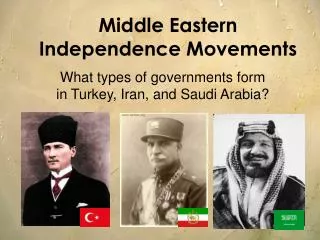
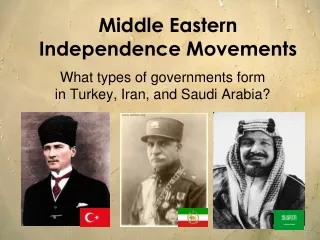
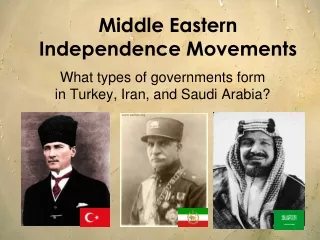
Middle East: Turkey • Kemal Mustafa (aka: KemalAtatürk) • WWI hero, who led Turks against Allied plans • October 1923 • Turks had already defeated Greeks • announced establishment of Turkey
Middle East: Turkey • Kemal Mustafa changed to KemalAtatürk • Atatürk means “Father of the Turks” • government in Turkey was TOTALLY SECULAR • government had nothing to do with & was not influenced by religion
Middle East: Persia/Iran • 1921 Reza Khan led overthrow of shah • 1925 Khan became shah himself • 1935 Persia becomes Iran
Middle East: French Mandate(s) • Syria & Lebanon • 1916 Husayn bin Ali led Arab nationalists against Ottoman control • wanted an independent Arab nation
Middle East: British Mandate(s) • Palestine & Iraq • Palestine • Jewish national movement = Zionism • wanted a Jewish homeland • 1921 Transjordan cut out of Palestine • supported by 1917 Balfour Declaration
Middle East: British Mandate(s) • Palestine & Iraq • Iraq • Husayn bin Ali’s son, Faisal = King of Iraq
Egypt vs. Britain • The British had occupied Egypt in 1882. • Egyptians’ dissent began in the early 1900’s, vying to expose the British monopolies within the bureaucracy. • British arrogance and superiority was seen in events like the Dinshawai Incident and the killing of pigeons in rural areas.
Egypt vs. Britain • After WWI, the Ottoman Empire disappeared. • By 1923, an independent Turkish republic had been established. • French and British forces occupied much of the Middle East, even after promises for Arab independence. • Syria, Iraq and Lebanon were carved out in the League of Nations. • Movements for Jewish occupation in Palestine were seen after WWI, but Turks were promised independence after the war.
Egypt vs. Britain • During the war, the British defended the Suez Canal and used critical resources from Egypt in the war. • After protests, British withdrawal began in 1922 and didn’t end until British withdrawal of the Suez Canal in 1936. • Even though Egypt had independence, Egyptian politicians were concerned more with power and wealth, than with helping the poor.
Sub-Saharan Africa, 1900-45 • Sub-Saharan Africa, 1900-45 • Colonial Africa: Economic and Social Changes • African Farmers – few profit from high price cocoa & palm oil • African Health – modern technology brought, migrant workers spread disease
Sub-Saharan Africa, 1900-45 • Religious and Political changes • Christianity & Islam schools – Christian (West & South), Islam (East & South) • Islam fit more with traditional African polygamy • Senegal – Blaise Diagne elected to French National Assembly – advocate for African rights • African National Congress – founded by western educated Africans to defend interests • Africa in WWII – Haile Selassie (Ethiopia) takes on Italians, • Like India, Africans return from WWII changed, looking for independence
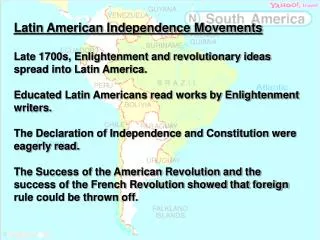
Argentina and Brazil, 1900-49 • President Obregon succeeded by Calles who founded National Revolutionary Party (PNR) • PNR – collection point for working out ideas of revolution • President Cardenas – redistributed land, removed generals from government positions, nationalized oil industry • Art flourishes – murals and painting: Clemente Orozco, Diego Rivera, and FridaKahlo
Argentina and Brazil, 1900-49 • Transformation of Argentina • Most of Argentina pampas = flat fertile land • Oligarquia – ruled by small group of wealthy land owners that lived in Buenos Aires • British allowed to run domestic industries, US & Britain supply manufactured goods
Argentina and Brazil, 1900-49 • Brazil & Argentina to 1929 • Before WWI = coffee, cacao, and rubber • Rio de Janeiro the city of choice • Collapse of rubber (lost to SE Asia) and WWI, middle class elect HipolitoIrigoyen • US replaces Europeans as supplier of manufactured goods • Post WWI – Trade with Europe resumes, middle class push for reforms, take over industry • South America still lags behind US & European technologically
Argentina and Brazil, 1900-49 • The Depression and the Vargas Regime in Brazil • Argentina & Brazil go towards authoritarian regimes to solve economic problems • Getulio Vargas (a bad loser) – coup, puts Brazil on industrial path • The environment – Favelas (slums) occupy hillsides • Vargas’s legacy – when failing to win reelection, another coup = Caudillo
Argentina and Brazil, 1900-49 • Argentina after 1930 • Gen Uriburu overthrows Irigoyen (1930), Col Peron overthrows Uriburu (1943) • Eva Peron champions the descamisados (“shirtless ones” – urban workers) • Spends heavily on social programs, when wife dies (1952), loses election.