Calibration of Pyrgeometers Using Regression: A Comparative Study of Three PIRs
100 likes | 231 Vues
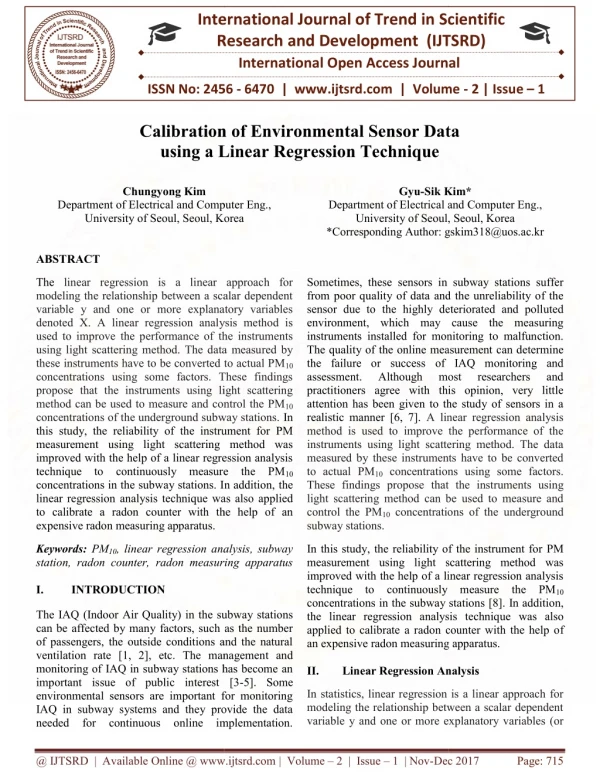
This study presents the calibration of three pyrgeometers (PIRs) against the WISG reference at Davos, using a regression technique. The calibrations were conducted outdoors over several weeks, comparing the triad average against various regression methods, including those by Cox & Albrecht, Reda et al., and Philipona. The results indicate that assuming the WISG is an absolute reference, Cox and Albrecht yield uncertainties of 3-4 W/m², while Reda et al. and Philipona achieve approximately 1.25 W/m² uncertainties with no significant diurnal variations.


Calibration of Pyrgeometers Using Regression: A Comparative Study of Three PIRs
E N D
Presentation Transcript
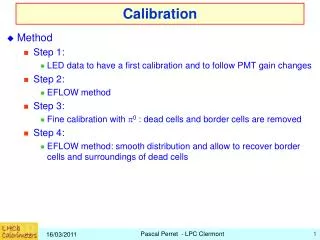
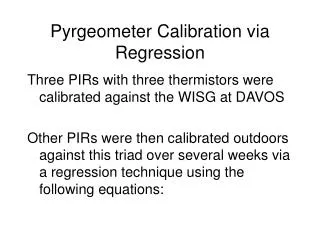
Pyrgeometer Calibration via Regression Three PIRs with three thermistors were calibrated against the WISG at DAVOS Other PIRs were then calibrated outdoors against this triad over several weeks via a regression technique using the following equations:
Comparison of Triad Average vs Cox & Albrecht Regression Calibration of PIR
Comparison of Triad Average vs Reda et al. Regression Calibration of PIR
Comparison of Triad Average vs Philipona Regression Calibration of PIR
Conclusions • Assuming the WISG is an absolute reference - Cox and Albrecht produce 2 uncertainties of 3-4 Wm-2 with noticeable diurnal differences - Reda et al. or Philipona produce 2 uncertainties of 1.25 Wm-2 with no large diurnal differences • A problem (Forgan comment) is that the values of these regressed coefs differs significantly from the blackbody+oudoor calibration