Download
1 / 7
70 likes | 222 Vues
The Ideal Gas Law is based on key assumptions of the kinetic molecular theory, which describes ideal gases as having zero volume and no intermolecular forces, moving in straight lines and colliding elastically. However, under high pressure and low temperature, these assumptions break down, leading to significant interactions and contributions from the volume of gas molecules. This text explores Boyle's Law, Charles' Law, and Avogadro's Law, alongside the equation PV = nRT, where R is the ideal gas constant. Practical applications and homework exercises are also provided for deeper understanding.

E N D
Real Gas Behaviour • There are several assumptions in the kinetic molecular theory that describe an ideal gas • Gas molecules have zero volume • Forces of attraction/repulsion are zero • Molecules move in straight lines • Collisions are completely elastic • However, at high pressure and low temperature there are problems with these assumptions • In very small volumes there will be many more interactions and collisions • The volumes of the gas molecules is now a significant fraction of the container
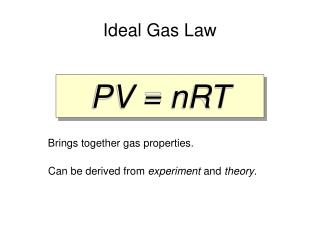
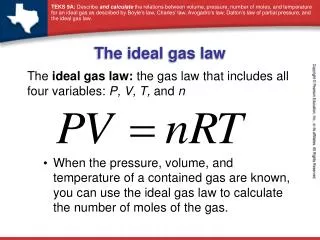
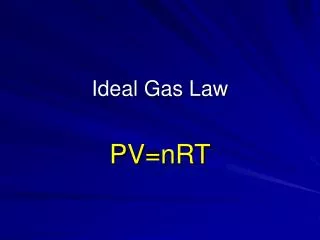
The Ideal Gas Law Boyle’s Law: PV = k or V = k P Charles’ Law: V = k or V = aT T Avogadro’s Law: V = b or V = bn n V = kab X nT P V = RnT or PV = nRT P
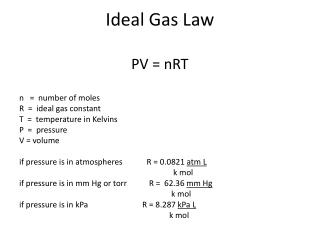
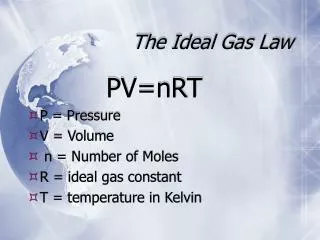
PV= nRT Unit Analysis! PV = nRT R = PV nT R = (kPa)(L) (mol)(T) R = 8.314 kPa·L/mol·K P = pressure (kPa) V = volume (L) n = amount (mol) T = temperature (K) R = ??
Try These… • Use the ideal gas law to calculate the molar volume of a gas at SATP. • A cylinder of laughing gas (N2O) has a diameter of 23.0 cm and a height of 140 cm. The pressure is 108 kPa at a temperature of 294 K. How many grams of laughing gas are in the cylinder? Hint: Vcylylinder = r2h
Homework • Read p. 443-445 • P. 445 #3,4,6 • P. 448 #1-6