Download
1 / 23
230 likes | 332 Vues
This comprehensive overview explores the fundamental concepts of atoms, orbitals, and functional groups within the realm of chemistry. The periodic chart is introduced as a vital tool for identifying elements, where each element is defined by its unique number of protons. Key elements that constitute the human body are highlighted, alongside an explanation of atomic structure, subatomic particles, and electron configuration. Additionally, the importance of functional groups in organic compounds is emphasized, showcasing how the arrangement of atoms influences chemical properties and reactivity.

E N D
Introduction • The Periodic Chart • Is a listing of known elements • Element • A substance composed of atoms having an identical number of protons in each nucleus.
Common Elements • Hydrogen, carbon, nitrogen and oxygen make up 96.5% of the human body weight • Individually, the following elements make up 0.1-1.5% of the human body weight • Sodium • Magnesium • Phosphorus • Sulfur • Chlorine • Potassium • Calcium
Description • The smallest particle of an element • All known elements are found on the Periodic Chart. • Has two main sections • Nucleus • Out Shell
Introduction • There are three subatomic particles • Protons • Found within the nucleus • Neutrons • Found within the nucleus • Electrons • Found in the outer shell
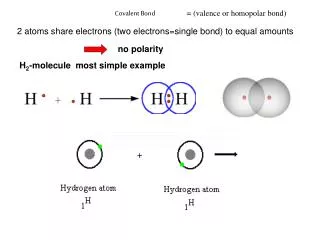
Introduction • Protons • Positive charge • Neutrons • Neutral charge • Electrons • Negative Charge • Surround the atom • Used in the formation of chemical bonds
Shells (aka Energy Levels) • Shells may be thought of as layers in which electrons are found. • Represented pictorially by the Bohr Model. • The shells, represented by numbers, contain a maximum number of electrons • 1 = 2 e- • 2 = 8e- • 3 = 18 e- • 4 = 32 e-
Valence Electrons • The number of electrons found in the most outer shell. • Used to determine the type of, and how many, chemical bonds that are made.
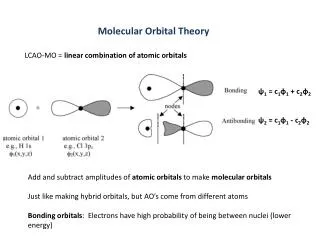
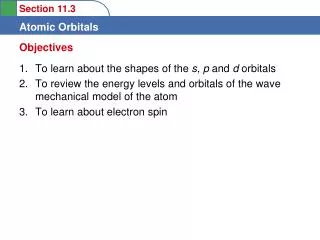
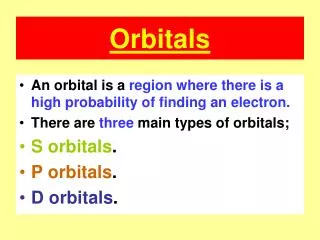
Orbitals • The volume of space, around the nucleus, where electrons are found. • **Used to calculate the number of electrons found in shells • Represented by letters • Each orbital also has a maximum number of electrons • s = 2 • p = 6 • d = 10 • f = 14 • The electron configuration displays the orbitals, and number of electrons found within, surrounding an atom.
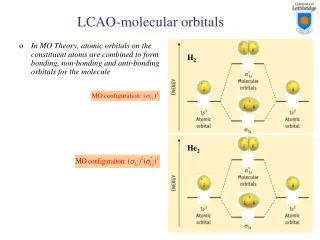
Hybrids • Developed by Linus Pauling in 1931 • Showed mathematically how orbitals on an atom, can combine and hybridize, to form equivalent atomic orbitals. • The concept explains how carbon forms four equivalent tetrahedral bonds but does not explain why it does so.
The Equation • The equation A = Z + N is used to calculate the atomic mass and the number of subatomic particles*. • Atomic Mass (A) • The absolute atomic mass of an atom • Atomic Number (Z) • The number of protons in the nucleus of an atom • N • The number of neutrons
Question • If the atomic mass of an element is 29, and the number of neutrons is 15, what element am I talking about? • A = Z + N • 29 = Z + 15 • Z = 29 - 15 • Z = 14 • What element has an atomic number of 14? • Si (Silicon)
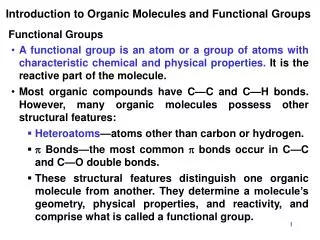
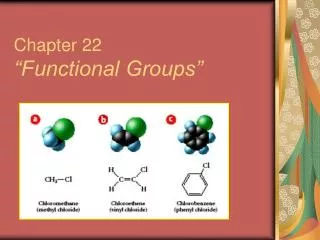
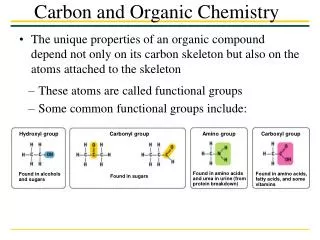
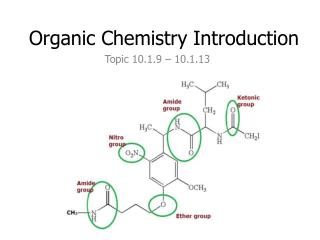
Description & Importance • A functional group is an atom, or group of atoms, that is responsible for the specific properties of an organic compound. • Organic compounds must contain carbon.