Download
1 / 8
80 likes | 211 Vues
Learn how to use direct and indirect object pronouns in Spanish to replace repetitive nouns and streamline your sentences. Understand the placement rules and examples.

E N D
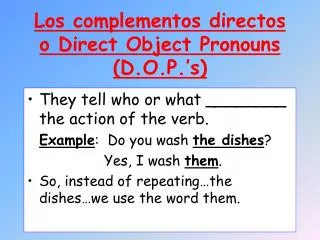
Los complementos directos o Direct Object Pronouns (D.O.P.’s) • They tell who or what ________ the action of the verb. Example: Do you wash the dishes? Yes, I wash them. • So, instead of repeating…the dishes…we use the word them.
Los complementos indirectos o IOP’s • They answer the questions “________?” or “_________?” the action is performed/intended. Example: Ana bought gifts for her friends. She bought gifts for them. • So, instead of repeating…her friends…we use the word them.
Ejemplos: • Ella llama a mí.* (D) Ella _____ llama. • Yo lavo los platos. (D) Yo _____ lavo. • Yo doy el regalo a ella. (I) • Yo _____ doy (a ella). *Remember that when a person is a direct or indirect object you must use “a personal.”
With infinitives • When there are _______ in a row and one is an infinitive the DOP may be attached to the end of the infinitive. Ejemplo: Nosotros tenemos que lavar el carro. Nosotros tenemos que ________.
Placement Rules • ________ the conjugated verb • Attached to the end of the _______________ *Note: Placement rules are the same for DOPs and IOPs!