
SlideServe
Menu
Préférences
© SlideServe · v2026

Classifying the Elements

groberts avatar
24 diapositives · 287 Views · Jan 02, 2020

Explore the significance of the elements' symbols and information displayed in the squares of the periodic table. Learn about the classification based on electron configurations and the characteristics of different groups and blocks of elements. ###
Classifying the Elements - slide 1
01 / 24Classifying the Elements
1 / 17

Télécharger la présentation

Classifying the Elements
Une image / un lien ci-dessous est fourni (tel quel) pour télécharger la présentation

Politique de téléchargement : le contenu du site vous est fourni TEL QUEL pour votre information et votre usage personnel ; il ne peut être vendu, concédé sous licence ni partagé sur d’autres sites sans l’accord de son auteur.Le contenu vous est fourni TEL QUEL, pour votre information et votre usage personnel uniquement. Téléchargez la présentation en cliquant sur ce lien. Lors du téléchargement, si vous ne parvenez pas à télécharger une présentation, l’éditeur a peut-être supprimé le fichier de son serveur.Pendant le téléchargement, si vous ne parvenez pas à obtenir une présentation, le fichier a peut-être été supprimé par l’éditeur.

F I N

Plus de contenu associé

Transcription de la présentation
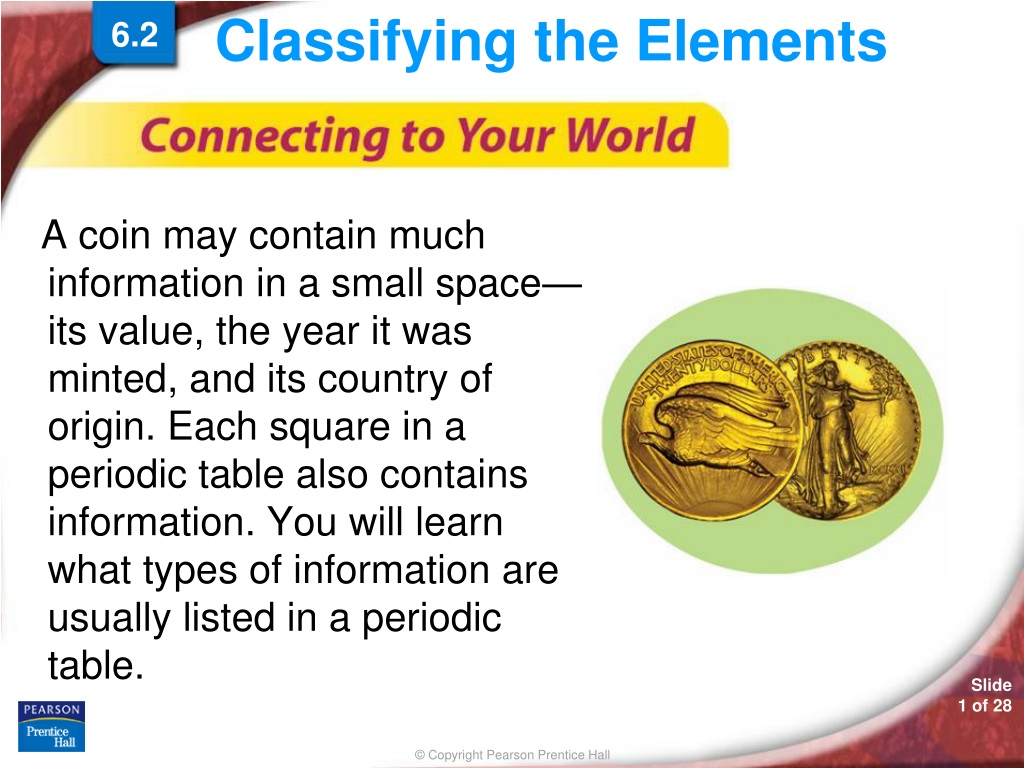
  1. Classifying the Elements 6.2 • A coin may contain much information in a small space—its value, the year it was minted, and its country of origin. Each square in a periodic table also contains information. You will learn what types of information are usually listed in a periodic table.

  2. 6.2 Squares in the Periodic Table • Squares in the Periodic Table • What type of information can be displayed in a periodic table?

  3. 6.2 Squares in the Periodic Table • The periodic table displays the symbols and names of the elements, along with information about the structure of their atoms.

  4. 6.2 Squares in the Periodic Table • The background colors in the squares are used to distinguish groups of elements. • The Group 1A elements are called alkali metals.

  5. 6.2 Squares in the Periodic Table • The Group 2A elements are called alkaline earth metals.

  6. 6.2 Squares in the Periodic Table • The Group 7A elements are called halogens.

  7. 6.2 Squares in the Periodic Table • The last group, group 8A are called noble gases.

  8. 6.2 Squares in the Periodic Table

  9. 6.2 Electron Configurations in Groups • Electron Configurations in Groups • How can elements be classified based on their electron configurations?

  10. 6.2 Electron Configurations in Groups • Elements can be sorted into noble gases, representative elements, transition metals, or inner transition metals based on their electron configurations.

  11. 6.2 Electron Configurations in Groups • The Noble Gases • The noble gases are the elements in Group 8A of the periodic table. The electron configurations for the first four noble gases in Group 8A are listed below.

  12. 6.2 Electron Configurations in Groups • The Representative Elements • Elements in groups 1A through 7A are often referred to as representative elements because they display a wide range of physical and chemical properties. • The s and p sublevels of the highest occupied energy level are not filled. • The group number equals the number of electrons in the highest occupied energy level.

  13. 6.2 Electron Configurations in Groups • In atoms of the Group 1A elements below, there is only one electron in the highest occupied energy level.

  14. 6.2 Electron Configurations in Groups • In atoms of the Group 4A elements below, there are four electrons in the highest occupied energy level.

  15. 6.2 Transition Elements • Transition Elements • There are two types of transition elements—transition metals and inner transition metals. They are classified based on their electron configurations.

  16. 6.2 Transition Elements • In atoms of a transition metal, the highest occupied s sublevel and a nearby d sublevel contain electrons. • In atoms of an inner transition metal, the highest occupied s sublevel and a nearby f sublevel generally contain electrons.

  17. 6.2 Transition Elements • Blocks of Elements

  18. 6.2 Transition Elements • Blocks of Elements

  19. Section Assessment • 6.2.

  20. 6.2 Section Quiz • 1. Which of the following information about elements is usually NOT included in a periodic table? • color • symbol • atomic number • atomic mass

  21. 6.2 Section Quiz • 2. An alkali metal would have in the highest occupied energy level • an s2 electron. • an s1 electron. • p2electrons. • p6 electrons.

  22. 6.2 Section Quiz • 3. Which one of the following is incorrectly labeled? • Ne, noble gas • Cu, transition metal • Ga, transition metal • Cl, halogen

  23. 6.2 Section Quiz • 4. Transition metals are characterized as being different than representative elements because they have electrons in which suborbitals? • p • d • s • f

  24. END OF SHOW