The Shoulder Girdle
420 likes | 1.1k Vues
This comprehensive overview explores the anatomy and physiology of the shoulder girdle, focusing on its bones, muscles, and joints. It covers critical aspects like the scapula and clavicle, discusses dynamic stability, and examines movements such as elevation, depression, abduction, and rotation. Key muscles involved in shoulder girdle movements, including trapezius, rhomboids, serratus anterior, and pectoralis minor, are detailed, along with their functions and attachments. This knowledge is essential for understanding shoulder mechanics in human movement.


The Shoulder Girdle
E N D
Presentation Transcript
The Shoulder Girdle Anatomy and Physiology of Human Movement 420:050
Objectives • Bones, bony landmarks and joints • Muscles • Movements
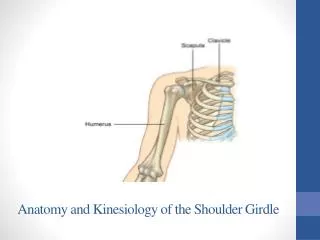
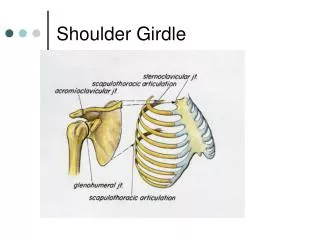
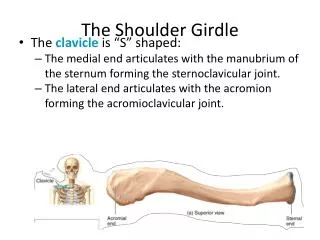
The Shoulder Girdle • The scapula and clavicle • Two joints • Functions • Dynamic stability • Increased ROM
From Seeley RR, Stephens TD, Tate P; anatomy and physiology, ed 7, New York, 2006, McGraw-Hill
From Seeley RR, Stephens TD, Tate P; anatomy and physiology, ed 7, New York, 2006, McGraw-Hill
Joints • Shoulder girdle (scapulothoracic) • Scapula moves on the rib cage • Joint motion occurs at sternoclavicular joint & to a lesser amount at the acromioclavicular joint
Joints • Sternoclavicular (SC) • (Multiaxial) arthrodial/gliding classification • Movements • Anteriorly with protraction • Posteriorly with retraction • Superiorly with elevation • Inferiorly with depression
Joints • Acromioclavicular (AC) • Arthrodial/gliding classification • Movements • Some gliding & rotational motion accompanying other shoulder girdle & shoulder joint motions • Often injured
Objectives • Bones, bony landmarks and joints • Muscles • Movements
Muscles • Five muscles primarily involved in shoulder girdle movements • All originate on axial skeleton & insert on scapula and/or clavicle • Do not attach to humerus & do not cause shoulder joint actions • Functions: • Stability • ROM of shoulder joint
Shoulder Girdle Muscles • Five muscles primarily involved in shoulder girdle movements • Trapezius - upper, middle, lower • Rhomboid - deep • Levator scapula • Serratus anterior • Pectoralis minor - deep
Objectives • Bones, bony landmarks and joints • Muscles • Movements
Movements • Focus on specific bony landmarks • inferior angle • glenoid fossa • acromion process • Shoulder girdle movements = scapula movements
Movements • Elevation • upward or superior movement, as in shrugging shoulders • Depression • downward or inferior movement, as in returning to normal position
Movements • Abduction (protraction) • scapula moves laterally away from spinal column • Adduction (retraction) • scapula moves medially toward spinal column
Movements • Upward rotation • turning glenoid fossa upward & moving inferior angle superolaterally away from spinal column • Downward rotation • returning inferior angle inferomedially toward spinal column & glenoid fossa to normal position
Adduction Elevation Shoulder GirdleMovements Abduction Upward Rotation Downward Rotation Depression
Movements • Anterior tilt (upward tilt) • Rotational movement of scapula about frontal axis • Occurs during glenohumeral hyperextension • Posterior tilt (downward tilt) • Rotational movement of scapula about frontal axis • Occurs during glenohumeral hyperflexion
Movements • Lateral tilt (outward tilt) • Rotational movement about its vertical axis • Occurs during protraction • Medial tilt (return from lateral tilt, inward tilt) • Rotational movement about its vertical axis • Occurs during retraction
Movements • Shoulder joint & shoulder girdle work together • Shoulder girdle movement independent • Upward/downward rotation? • Shoulder girdle muscles • Stabilize scapula • Enhance ROM of shoulder joint
ELEVATION • Proximal attachment: Above or below scapula/clavicle? • How many muscles fit this criteria? • Upper fibers trapezius • Middle fibers trapezius • Rhomboids • Levator Scapulae
DEPRESSION • Proximal attachment: Above or below scapula/clavicle? • How many muscles fit this criteria? • Lower fibers trapezius • Pectoralis minor • Subclavius
RETRACTION • Proximal attachment: In front (ribs) or behind (spine)? • How many muscles fit this criteria? • Trapezius (all fibers) • Rhomboids • Levator scapulae
PROTRACTION • Proximal attachment: In front (ribs) or behind (spine)? • How many muscles fit this criteria? • Serratus anterior • Pectoralis minor
UPWARD ROTATION • Upward or downward torque? • How many muscles fit this criteria? • Trapezius (all fibers) • Serratus anterior
DOWNWARD ROTATION • Upward or downward torque? • How many muscles fit this criteria? • Pectoralis minor • Rhomboids