Download
1 / 161
1.62k likes | 2.01k Vues
Understand the nutrients essential for healthy plant growth, optimal soil conditions, and effective treatments for deficiencies. Learn about nitrogen, phosphorus, potassium, calcium, and other key elements vital for your vegetable garden's success. Discover how to maintain balanced soil pH levels and choose the right fertilizers and soil amendments for a thriving garden.

E N D
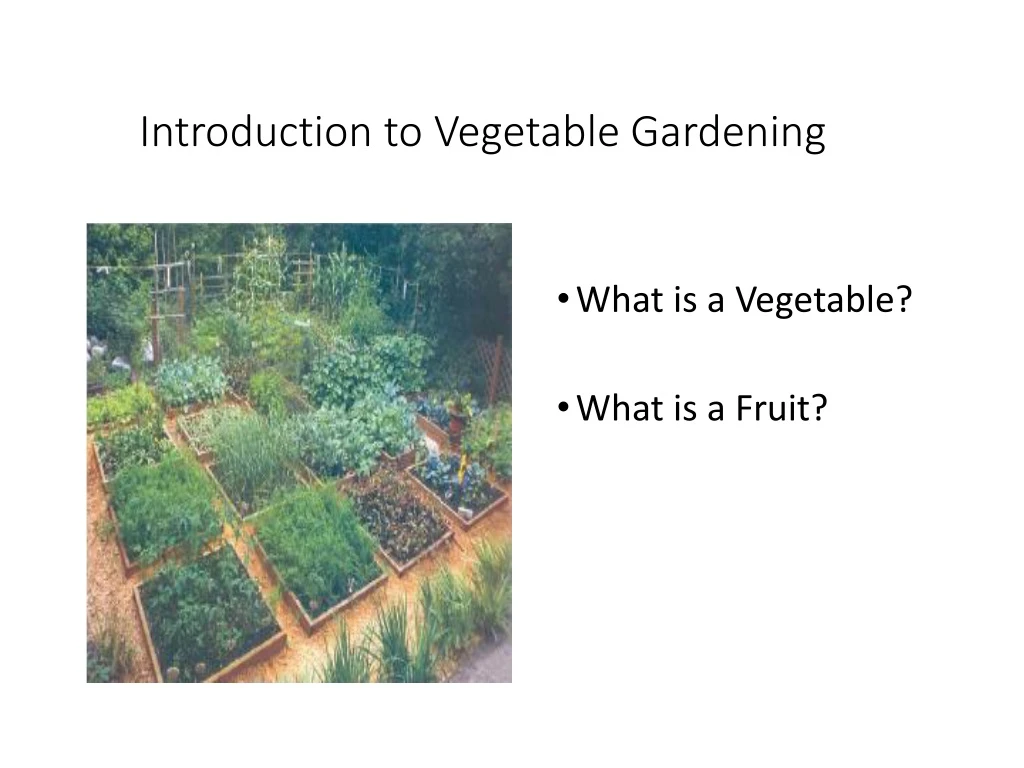
Introduction to Vegetable Gardening • What is a Vegetable? • What is a Fruit?
What is a Vegetable? • A vegetable is, typically, an herbaceous plant used for the main part of a meal • A vegetable is defined by use of the plant part and not some common botanical characteristic
What is a fruit? • A botanical definition for fruit is themature ovary of the plant, consisting of the seeds and their coating • A more general definition for fruit is the reproductive part of a plant; the seed of plants or the part that contains the seed
A quick review of soils and nutrition • Plants get the majority of the elements (nutrients) from the soil • Two stages to improving the soil in your garden • Create or rebuild a fertile and friable soil • Maintain fertility despite the drain of year-in, year out losses from leaching, erosion and vegetable harvest
Nutrients needed by plants • The way to determine if the soil contains adequate levels of nutrients is through a soil test • Make sure that your sample(s) for the soil test are representative of the garden • You can send the sample to a commercial laboratory or you can purchase and use a home soil testing kit
Major plant nutrients • Nitrogen (N) • The nutrient most likely to be deficient • Most soil nitrogen is contained in the organic matter • Is the essential building block of proteins and chlorophyll • Generally is in the nitrate or ammonium form or in organic matter in the soil
Nitrogen • Nitrate • Form used by the plants • Leaching losses • Denitrification- in waterlogged soils, N can be converted by microbes into atmospheric nitrogen • Nitrogen deficiency • Symptoms: Yellowing of the leaves, especially the older leaves • Treatment: apply a material high in nitrogen • Legumes, manures, animal byproducts, synthetic fertilizers
Nitrogen (N) • Excess nitrogen • Easy to over apply nitrogen • Will cause: • Delayed maturity • Uneven ripening • Overly succulent growth – can lead to pest problems
Phosphorus (P) • Generally considered to be in the form of phosphate (P2O5) • Most soils contain large amounts of P but not in forms available to the plant • Functions • It is important for the distribution and storage of energy in forms of sugars and starches • Is important for root growth • Stimulates flower, fruit, and seed development
Phosphorus (P) • Phosphorous deficiency • Symptoms: Slight stunting of the plant, older leaves will be purplish, and undeveloped root system • Treatment: • Apply bone meal • Apply a synthetic fertilizer containing a high level of phosphorous • Phosphorous does not move very much in the soil
Potassium or Potash (K) • Where did the name potash originate? • Considered to be in the form of K2O • Not leached readily • Is essential for synthesis of proteins and carbohydrates • Is needed in higher amounts by root crops • Organic fertilizers are often low in potassium
Potassium • Potassium deficiency • Symptoms: • Small inferior flowers and fruits and stunted plants. • Yellowing along the edges of older leaves • Leaves become bronzed • Treatment is to apply a fertilizer high in K
Calcium • Calcium • Plays an important role in cell wall development • Calcium deficiency problems: • Sometimes calcium is present, but plants cannot adequately distribute it (uneven irrigation practices…)
Calcium • Symptoms • Tipburn in lettuce and cabbage • Blossom-end rot in tomatoes • Treatment • There is no immediate “cure” for calcium deficiency problems • Adding materials high in calcium will not solve the problem • Maintain even watering • Mulch the plants • Maintains more even soil moisture
Secondary Nutrients • Magnesium • Magnesium deficiency • Symptoms: yellowing starting between the veins of the older leaves • Sulfur • Generally not a problem • Used for making soils more acidic and is found in compost and manures
Micronutrients • Are needed in very small quantities • Generally all micronutrients are available in organic materials you apply to the garden • Best treatment is to prevent the problem from occurring in the first place • Availability is determined by soil pH
Soil pH: Acidity and Alkalinity • What is pH? • pH is –log[H+] • pH is a scale from 1 to 14 • Why is pH important? • Because nutrients are more or less available depending on the soil’s pH • The ideal range is 6.2 to 6.8
Soil pH • Influences disease problems • Acid soils promote club root disease of cabbage • Adjusting the pH • Lime is used to raise the pH • Sulfur is used to lower the pH
Soil amendments/ Fertilizers • Animal manures • Are intermediate between a soil amendment and a fertilizer • Vary greatly in their nutrient composition • Caused by: • Animal • Feed used • Type of litter or bedding • Degree of composting or decomposition • Must be composted before use with minor exceptions
Animal Manures • Problems with manures • May contain harmful or undesirable contaminants • E coli and other harmful bacteria may be in fresh manure • Manures are low in nutrients compared to synthetic fertilizers • The most common commercially available types of manures • Cow manure • Chicken (Poultry) manure • Bat guano • Seabird guano
Starting your vegetable garden Seeds vs transplants
Starting Plants from Seeds • Introduction • Definition:A seed is a dormant, undeveloped plant • A seed contains all the genetic material necessary for the development of a mature plant • Basic parts • Seed coat • Embryo • Food supply in either endosperm or cotyledons
Factors Determining Seed Quality • Disease-free seed • You do not want to use contaminated seed because it may be very difficult to eliminate the disease from your garden • Generally seedborne diseases are a problem when gardeners collect their own seed • Ways diseases can be carried • On the seed coat • Seed treatments can eliminate • Within the seed • Hot water treatments can eliminate
Factors Determining Seed Quality • Disease-free seed • Some commercial seed companies treat their seeds with fungicides • Fungicide treated seed is not acceptable in organic gardening • Seed packet should contain warning if seed is Treated • If seed is pink or has powdery substance on it then it was treated with a fungicide • Wear gloves when handling
Factors Determining Seed Quality • Viability • Definition:viability is the percentage of vegetable seed which will germinate • Viability refers to is the seed living or respiring • Vegetable seed viability is tested by seed companies and on seed packets the germination percentage and test date are listed • Factors affecting viability • Vegetables naturally differ in their viability • Age of the seed will affect viability
Factors Determining Seed Quality • Seed Purity • Definition:seed purity means that the seed is true-to-type and does not contain undesirable contaminants • The seed are what the package says it is • Contaminants that may occur in seed packets • Seed of the wrong cultivar • Seed of the wrong vegetable species • Weed seed • Soil particles or plant parts
Factors Determining Seed Quality • Seed purity and noxious weeds • Definition: noxious weeds are plants that federal, state, or local governments want to prevent from spreading to and establishing in a particular area • These seed are prohibited from being contaminants in seed that are commercially sold • Examples • Field bindweed • Canada thistle
Factors Determining Seed Quality • Seed purity and collecting your own seeds • It is important to maintain the cultivar genetically pure when collecting your own seed • Maintaining genetically pure seeds only works for self-pollinated cultivars that are open pollinated • You can not maintain pure seed when: • The parents are hybrids • Wind pollinated vegetables • They can be pollinated by related plants from a distance away • Insect pollinated vegetables readily cross pollinate, if required distances are not kept
Factors to consider whenplanting seed • Germination requirements • Soil temperature • Soil moisture • Light / dark • Planting depth
Germination requirements • Soil temperature • Plant processes including seed germination and vegetative growth are temperature dependent • Soil temperature and moisture are closely interrelated • Wet soils are cooler than dry soils • In cold soils seedlings emerge slowly and are prone to attack by soilborne pathogens
Germination requirements cont. • Each vegetable crop has: • An optimum temperature for germination • Temperatures below or above which germination will not occur • The response of most biological processes such as germination to temperature is a sigmoidal (bell-shaped) curve
Germination Requirements • Soil Moisture • Soil moisture ranges from the permanent wilting point (lowest moisture) to field capacity (highest moisture) • Field capacity: the maximum amount of water that your particular soil will hold • Permanent wilting point: point where a plant can no longer remove the small amount of water remaining in the soil and the plant wilts • Plants varying in their ability to germinate at different soil moistures • Low moisture: cabbage, pumpkin • High moisture: beets, lettuce
Planting Depth • Planting depth • Seed has a limited amount of food reserves and can exhaust those before it reaches the surface, if planted to deep • Rule of thumb: vegetable seeds should generally be planted to a depth equal to twice the diameter of the seed
Planting Depth • Factors influencing depth of planting • Weather conditions • Wet weather plant seed shallower • Type of soil • Heavy soils plant seed shallower • Soil crusts • Some of our soils tend to form crusts • Plant shallower or apply vermiculite or peat moss over the seed
Starting Plants from Transplants • Definition– transplanting is the shifting of plants from one soil or growing medium to another • Goal is to produce vigorous plants ready to be planted in the garden
Why use transplants? • Improves the earliness of the vegetables • Avoids problems of seed emerging through soil crusts or in cold soils • You can more closely control depth of planting • Make best use of expensive or unavailable seeds • Seed germinates under ideal conditions
Not all vegetables transplant well • Plants difficult or not to transplant include: • Root crops (carrots) • Leafy biennial herbs (dill and fennel) • Heading types of Chinese cabbage • Cucurbits (cucumbers, pumpkins, squash) • Do not like their root systems disturbed • Vegetables growing quickly when seeded in the garden (lettuce, spinach) • Transplanting is not worth the effort
Vegetables TraditionallyTransplanted • Small seeded vegetables • Tomatoes, peppers, cabbage, broccoli • Some vegetables are traditionally started from transplants because they do not produce seed or the seed lacks uniformity • Sweet potato, Irish potato
Commercially Available Transplants • To select quality transplants look for: • Healthy plants • Free of insects or diseases • Vigorously growing • Avoid transplants that already have flowers or small fruit – a sign of stress, or are spindly • "True to type“ • All the plants are actually the vegetable and “variety” / cultivar that the label indicates • Properly handled
Commercially Available Transplants • To select quality transplants look for: • Transplants that are not leggy or spindly • A source that regularly deals with transplants • Purchase transplants early in the season before they are picked over
Producing your own transplants • Key factor in determining success – • Having an adequate amount of protected growing space to produce transplants • May need: • Specialized structure • Supplemental lights
Producing your own transplants • Growing Media • Want to use a soil-less growing media that does contain soil from your garden or yard • Why not use garden soil? • Tends to be poorly drained and subject to water logging • Contains insect pests, diseases, and weed seed or mostly big rocks • Serpentine soil
Producing your own transplants • Light • Is the environmental factor that is most likely to be limiting for growing your own good quality transplants • Interrelated with temperature and moisture • Inadequate light often leads to cold temperatures and too much moisture • Too little light causes weak spindly plants susceptible to diseases • Vegetable transplants need more light than standard houseplants
Producing your own transplants • Light • Components of light • Intensity • Wavelength • Plants require different wavelengths than our eyes perceive • Day length • Plants use day length to tell when summer or winter is coming • Inadequate levels of any of these components will cause a plant to sense inadequate level of light
Producing your own transplants • Temperature • In windows there can often be large temperature fluctuations between day and night or sunny and cloudy days • Cooler than optimum temperatures may: • Encourage disease • Cause rough fruit in tomatoes • Cause bolting in biennials • Warmer than optimum temperature may cause weak spindly seedlings
Producing your own transplants • Moisture • Too much moisture is often associated with cool temperatures and dark conditions • Too much water is associated with diseases which require moisture for spread • Examples: root rots, leaf spot • Ways to avoid problems with diseases fostered by too much water • Thoroughly water when seeding • After seeding water in the morning so leaves will be dry before night and spot water only the dry places • Too little water rapidly kills young seedlings