Download
1 / 20
220 likes | 341 Vues
This chapter explores ecological succession, investigating temporal patterns in communities where one species replaces another within specific habitats. It distinguishes between degradative succession, driven by decomposers breaking down organic matter, and autotropic succession, which occurs in habitats continually occupied by organisms. Various types, including allogenic and autogenic succession, are examined, alongside primary and secondary succession triggered by natural events. The chapter also discusses pioneer species and the dynamics that lead to community stability, climax stages, and how disturbances reset ecological succession.

E N D
Community Ecology Chapter 9
Succession • Temporal patterns in communities • Replacement of species by others within particular habitat (colonization and extinction) • Non-seasonal, continuous, directional
Degradative succession • Decomposers breaking down organic matter • Leads to disappearance of everything, species included
Autotropic succession • Does not lead to degradation • Habitat continually occupied by living organisms
Two types of autotropic succession • Allogenic succession • Autogenic succession
Allogenic succession • Serial replacement of species driven by changing external geophysical processes • Examples: • 1) silt deposition changing aquatic habitat to terrestrial habitat • 2) increasing salinity of Great Salt Lake
Autogenic succession • Change of species driven by biological processes changing conditions and/or resources • Example: organisms living, then dying, on bare rock
In an area that previously did not support any community Primary succession Example: terrestrial habitat devoid of soil In an area that previously supported a community, but now does not Secondary succession Example: terrestrial habitat where vegetation was destroyed, but soil remained Autogenic succession can occur under 2 different conditions
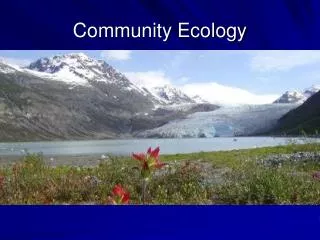
Primary succession • Volcanic eruptions • Glaciers
Secondarysuccession • Floods • Fires
Rate of succession • Primary - slow - may take 1000s of years • Secondary - faster - fraction of the time to reach same stage
Autogenic succession begins… • First community comprised of r-selected species - pioneer species
r-selected species • Good colonizers • Tolerant of harsh conditions • Reproduce quickly in unpredictable environs • Example: lichens
Pioneer species • Carry out life processes and begin to modify habitat • Extract resources from bare rock • Break up/fragment rock with roots • Collect wind-blown dust, particles • Waste products accumulate • Die and decompose • Soil development begins
Continuing change • Colonizers joined by other species suited for modified habitat • Eventually replace colonizers • Better competitors in modified habitat • Less r-selected, more K-selected
More change • Communities gradually become dominated by K-selected species • Good competitors, able to coexist with others for long periods of time
Stability • Communities become stabilized • Reach equilibrium • Little or no change in species composition, abundance over long periods of time • Climax community • End stage of succession
Will climax stage be reached? • Rarely is climax stage reached quickly • Slow succession most common, climax stage almost never achieved • Community usually affected by some major disturbance (e.g., fire) before climax stage is reached • Resets succession, forces it to start again from some earlier stage