Download
1 / 16
160 likes | 277 Vues
This presentation addresses the complexities of ontology creation in multilingual contexts, drawing from experiences with the NeOn and Concept Server projects. Key highlights include the need for modular models and efficient tools that enhance data integration and service provision across various languages. Topics covered include the use of multilingual resources like AGROVOC and FAOTERM, requirements for supporting multi-language terminology management, and the challenges posed by different linguistic structures. Discover solutions for semantic-based searches and collaborative management of multilingual data.

E N D
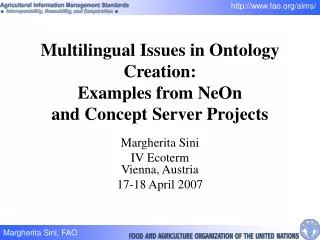
Multilingual Issues in Ontology Creation: Examples from NeOn and Concept Server Projects Margherita Sini IV EcotermVienna, Austria 17-18 April 2007
Outline • Why and What • Needs and Status • Requirements • for models • for tools • The AGROVOC/CS Workbench
Why • FAO data are multilingual • To integrate data • To provide better services to users • semantically-based or concept-based searches • multilingual search assistants • text processing for document finger-printing • concept-based indexing • (semi-) automatic translation assistants • Each language is different in alphabet characteristic and structure
What • Multilingual resources (AGROVOC, FAOTERM, Glossaries, etc.) • Documents (at least 5 official languages) • Databases • statistical • others
Needs • Models • modularization • versioning • Tools • efficient management • worldwide • collaborative Use of semantic-oriented technologies
Status • One-to-One correspondence based on agreements and convention (e.g. names of countries and organizations) • Reference Table Management System (RTMS) • Data based on cultures and languages • AGROVOC • FAOTERM
Requirements for models • Concept, Term, String level • Concept and Terms correspondences • one-to-one, one-to-many, many-to-one, one-to-nothing, many-to-nothing • Context • Relationships (culturally-driven) • Notations • e.g. comments, definitions, and images
Requirements for tools • UTF-8 and/or UTF-16 • Reference to ISO standard codes or legacy codes • Support left-to-right and right-to-left • Select one or more languages(for editing, export or visualization) • Easy add new languages • Functionalities to check and maintain the quality of the content
AGROVOC/CS Workbench • Support and manage the multi-language terminology work of information management specialists in the development, maintenance, and quality assurance of the AGROVOC/CS • A collaborative tool
DEMO http://chopin.cpe.ku.ac.th:8085/aoscsMain/Main.html http://chopin.cpe.ku.ac.th:8085/aoscsMain/MainMenus.html http://chopin.cpe.ku.ac.th:8085/aoscs/concept.html http://chopin.cpe.ku.ac.th:8085/aoscsMain/MainMenus.html
Thank you! Terima kasih Gratias Asante Aske Hvala Merci Webare Grazzi Vandane Dankon Dêkuji Gràcies Agyamanac Dankie Nasima Kamsahamnida Chjóonte Kiitos Grazia Arigato Margherita Sini Caterina Caracciolo Tak Makasih Faleminderit Dziakuju Danke Toda Gràsce Tashakkur Tänan Achiu Köszönöm Rekhmet Efcharisto Shukran Takk Dank u Dhanyabad Khawp jai Grazie Gratzia