Near-Infrared Observations of the 2003 October 29 X10 White-Light Solar Flare
90 likes | 225 Vues
This report discusses the near-infrared (NIR) observations at 1.56 microns of the X10 white-light solar flare that occurred on October 29, 2003. The observations were made using the Dunn Solar Telescope, employing high-order adaptive optics for enhanced clarity. The temporal evolution of NIR flare ribbons and their separation speeds in magnetic fields are analyzed, revealing significant findings about intensity enhancement and temperature perturbation, indicating a substantial energy output during the flare event.


Near-Infrared Observations of the 2003 October 29 X10 White-Light Solar Flare
E N D
Presentation Transcript
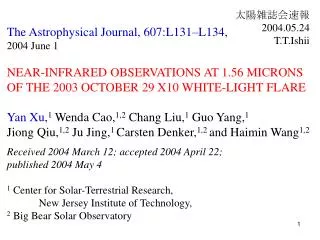
太陽雑誌会速報 2004.05.24 T.T.Ishii The Astrophysical Journal, 607:L131–L134, 2004 June 1 NEAR-INFRARED OBSERVATIONS AT 1.56 MICRONS OF THE 2003 OCTOBER 29 X10 WHITE-LIGHT FLARE Yan Xu,1 Wenda Cao,1,2 Chang Liu,1 Guo Yang,1 Jiong Qiu,1,2 Ju Jing,1 Carsten Denker,1,2 and Haimin Wang1,2 Received 2004 March 12; accepted 2004 April 22; published 2004 May 4 1 Center for Solar-Terrestrial Research, New Jersey Institute of Technology, 2 Big Bear Solar Observatory
Near-infrared (NIR/1.6mm) image of the X10 flare Dunn Solar Telescope at Sac Peak with high-order AO (adaptive optics) FOV: 91”×91” CCD: 1024×1024 →0.0089”/pixel 2003-Oct-29 20:42 UT Flare onset: 20:37 peak: 20:49
NIR time sequence of the X10 flare with RHESSI HXR contour from 20:40 to 20:47 (1 image / 1 min.) Blue: RHESSIHXR contour (50-100 keV channel) Red: local NIR intensity maxima (flare ribbons in NIR)
Temporal evolution of the NIR flare ribbons on SOHO/MDI longitudinal magetogram Separation speed: 38 km/s within weak field (700 G), 19 km/s (1400G)
Forbes & Priest (1984) and Forbes & Lin (2000) Ec: electric field strength along the current sheet vt : ribbon separation speed Bn: longitudinal magnetic field (near disk center) ⇒ Ec= 45 V/cm (much larger than previous results) Intensity enhancement (18-25 % to quiet-Sun in NIR) → temperature perturbation Wang et al. (1998) → radiative loss ⇒ 1031 ergs within 8 minutes
太陽雑誌会速報 2004.05.24 T.T.Ishii The Astrophysical Journal, 607:L59–L62, 2004 May 20 ON THE ORIGIN OF SOLAR FACULAE C. U. Keller,1,2 M. Schüssler,1 A. Vögler,1 and V. Zakharov1 Received 2004 March 9; accepted 2004 April 5; published 2004 April 22 1 Max-Planck-Institut für Aeronomie 2 On sabbatical leave from the National Solar Observatory
Numerical MHD simulations (100×288×288 grid points) ab initio three-dimensional simulations of nongray radiative magnetoconvection in the solar surface layers with the MURaM code (Max-Planck Institute for Aeronomy and University of Chicago Radiative Magnetohydrodynamics code) http://www.linmpi.mpg.de/~msch/Thesis_Voegler.pdf
Observation Lites et al. 2004 LaPalma 1m Swedish Solar Telescope Simulation B=400G q = 60 deg. (viewing angle) Upward = Limb-ward
Bright wall model Continuum intensity & Slices of physical quantities (dash line: continuum level) →Limb-ward




![[ t-t-t ]](https://cdn1.slideserve.com/3099327/slide1-dt.jpg)