Future Population Dynamics: Malthus vs. Boserup and Urbanization Trends
This overview explores future population predictions through contrasting theories of Thomas Malthus and Ester Boserup. Malthus argues that food production grows arithmetically while population increases geometrically, leading to potential self-regulation through famine. On the other hand, Boserup believes that agricultural advancements can sustain growing populations. The demographic transition model illustrates shifts in birth and death rates, and urbanization trends reveal rapid growth in megacities, presenting challenges like overcrowding and health issues that require sustainable solutions.

Future Population Dynamics: Malthus vs. Boserup and Urbanization Trends
E N D
Presentation Transcript
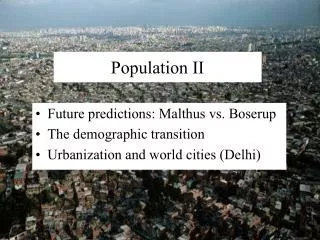
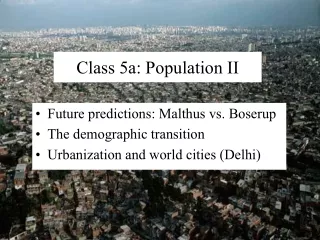
Topics Covered • Future predictions: Malthus vs. Boserup • The demographic transition • Urbanization and world cities (Delhi)
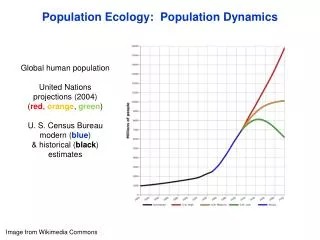
Future population • Doubling time = 70 ÷ rate of natural increase
Future population • Doubling time = 70 ÷ rate of natural increase
Future population: Thomas Malthus • Essay on the Principle of Population (1798) • Observing the Industrial Revolution • Food is necessary for human existence • "The passion between the sexes is necessary and constant"
Future population: Malthus • Food production grows arithmetically, but population grows geometrically
Future population: Malthus • Food production grows arithmetically, but population grows geometrically
Future population: Malthus • Food production grows arithmetically, but population grows geometrically • Therefore, the human population will self-regulate by means of famine • Ecological view of humanity
Demographic transition • Shift from high birth and death rates to low birth and death rates
Demographic transition • Stage 1: pre-industrial • High birth rate; high, fluctuating death rate
Demographic transition • Stage 2: industrial • Birth rate stays high • Death rate drops with better living conditions
Demographic transition • Stage 3: urbanized • Birth rate drops; death rate stays low • Growth begins to taper off
Future population: Ester Boserup • Conditions of Agricultural Growth (1965) • Technological improvements keep food production ahead of population • "Overpopulation" actually drives agricultural improvement • Social scientists’ view of humanity
Future population • Increasing emphasis on quality of life • Reproductive health care • Women’s rights and development
Urbanization • Just under half world population • But most growth is in cities • Overcrowding, food security, health
Urbanization • Historically follows industrialization • Industrial Revolution: Europe from 12% to 36% • 1850-1910, North America from 16% to 40%
Urbanization • 1950-1990, Third World from 17% to 37% • Most rapid in history • But without economic growth • And without urban decentralization
Urbanization: megacities • Population over 10 million • Disproportionately large economic activity • From 5 in 1970 to 26 in 2015 • Strong income disparities • Environmental and health problems • Lack of infrastructure