Understanding Electricity: Charge, Circuits, and the Basics of Electric Flow
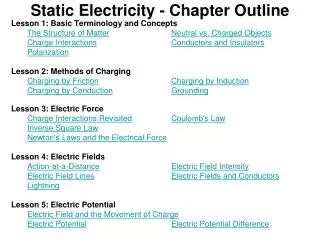
This chapter delves into the fundamental concepts of electricity, exploring the nature of electric charge, the structure of atoms, and the roles of protons, neutrons, and electrons. We discuss how opposites attract while like charges repel, and the distinct types of electricity: static and current. The text also distinguishes between conductors and insulators, details the workings of batteries, and describes methods of charging objects. Electric circuits, including series and parallel types, are explained with Ohm’s Law to illustrate voltage, current, and resistance relationships.

Understanding Electricity: Charge, Circuits, and the Basics of Electric Flow
E N D
Presentation Transcript
Charge comes from Parts of the Atom • Nucleus (middle) • Protons – positive • Neutrons – neutral • Outside • Electrons – negative • It is the electron that is free to move & causes electricity
How charges interact Opposites Charges Attract & Like Charges Repel
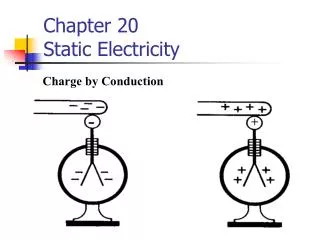
Neutral and chargedobjects • Any charged object - will have an attractive force on a neutral object. • Positivelycharged objects attractNeutralobjects • Negatively charged objects also attractNeutralobjects
Types of electricity • Static electricity is stationary or the build up of charge on the surface of an object • Current electricity is the flow of electrons through a conductor. • Flows from high to low voltage
Conductors vs. Insulators • Conductor: a material that allows electric current to pass. • Metals are good conductors • Insulator: a material that doesn’t allow electric current to pass. • Plastic, glass, wood, and rubber are good insulators
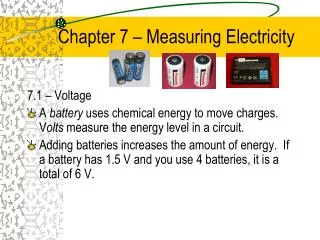
Batteries • Batteries: Devices that converts chemical energy to electricity. A battery provides a voltage source. dry cell contains a moist chemical paste surrounding a carbon rod suspended in the middle. Ex. AA, AAA, C, etc
wet cell contains two connected metal plates in a conducting solution. Ex. Most car batteries
Charging Objects • Charging by Contact • Transfer charge by touching or rubbing • Leaves one object with a (+) charge and the other with (-) charge • Ex. Rubbing feet on ground builds up charge. • Charging by Induction • Rearrangement of charge on a neutral object by a nearby charged object • Ex. Touching something after charge was built up *SHOCK*
Electric circuits: contain a power source, wires, and devices that use the electrical energy. Series circuit: provides a single pathway for current to flow. If the circuit breaks, all devices using the circuit will fail. Ex. Cheap Christmas Lights
Parallelcircuit: has multiple pathways for the current to flow. If the circuit is broken the current passes through other pathways and other devices will continue to work. Ex. Homes, cars
Voltage Difference (V) • Voltage Difference—or just voltage (V): force that causes electric charges to flow • supplied by a battery or other power source. • Potential Difference is measured in Volts named in honor of Alessandro Volta
Electric Current (I) Electric Current (I): the rate or the flow of electrons in a circuit measured in amperes (amps)
Resistance (R) • Resistance (R): the opposition to the flow of electric current, causing the electrical energy to be converted to thermal energy or light. • Measured in ohms Ω
Ohm’s Law German physicist Georg Simon Ohm (1789 - 1854). V = I•R Voltage Difference= Current •Resistance Units: Volts= amps•Ω (ohms)
Series or Parallel Questions • The current is the same throughout. • The total resistance is equal to the sum of the individual resistances. • The voltage drop is the same across each resistor. • The voltage drop is proportional to the resistance. • Adding resistors decreases the total resistance. • If the current through one resistor goes to zero, there is no current in the entire circuit. • If the current through one resistor goes to zero, the current through the other resistors remain the same. • This form is suitable for house wiring.