Download
1 / 10
100 likes | 229 Vues
This document outlines the key deadlines and ongoing tasks related to the DC2 Data Challenge, including parameterization of energy definitions, implementation, and verification processes. Key deadlines include finalizing parameterization by February 10, implementation by February 13, and a final report due by February 20. Additionally, it addresses event classes A and B, along with issues related to energy dispersion and PSF calibration. The document emphasizes the need for improved treatment of low-energy events and modification of Class B definitions.

E N D
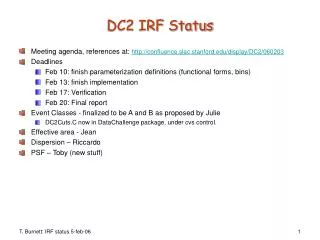
DC2 IRF Status • Meeting agenda, references at: http://confluence.slac.stanford.edu/display/DC2/060203 • Deadlines • Feb 10: finish parameterization definitions (functional forms, bins) • Feb 13: finish implementation • Feb 17: Verification • Feb 20: Final report • Event Classes - finalized to be A and B as proposed by Julie • DC2Cuts.C now in DataChallenge package, under cvs control. • Effective area - Jean • Dispersion – Riccardo • PSF – Toby (new stuff)
The calibration data – updated with new low energy • Photon response from “allgamma” • Version v7r3p4, with reprocess to update CTB variables • (4000-2)*50 K generated events into 6 m2: • uniformly in log(E) from 18 MeV to 180 GeV (4 decades) • uniform in cos() from -1 to 0 (upper LAT hemisphere) • (2000-1)*5 K generated 1.25 <log(E) < 3.75. (1.5 decades) • Factor of 40/3 more for E<562 MeV • Background • Version v7r3p5, also CTB updated, and filtered with CTBGAM>0 • 18675 seconds of live time, distributed uniformly over 3 days of the DC2 orbit new
PSF - Jean class A class B front back
Dispersion, cont • Parameterization of energy and angle in progress – needs more data at low energy, has not use the new run • Class B – big problem!
Class B: what to do with it • Substantial low energy tail in dispersion • These events will not be fit properly! • Is it worth it? I think not! But if we include them, we have to treat the analysis properly: the effective area for analyses that depend on the energy must be reduced ? good energy
PSF (Toby) • Revise scaling function so that 68% containment is ~1 for class A.
PSF, cont class A back • Since the fit is restricted to ~10 68% radii, there is a potential normalization issue, if the predicted tail is different from the measured one. • The largest class A deviation is at right • class A front fits are all within 0.1% overestimate: 0.5% underestimate: 1.6%
Addendum: new class B Riccardo suggested to modify the class B definition by requiring CTBGoodEnergyProb>0.3 for all events. Here are the resulting acceptances. The blue points are those for which the measured energy is >60% of the actual.