Download
1 / 1
10 likes | 126 Vues
This study presents an efficient method for maximum a posteriori (MAP) estimation in Markov random fields (MRFs) that utilize semi-metric pairwise potentials. We leverage hierarchical graph cuts to optimize estimation, enabling accurate results with a computational complexity of O(log H). The method incorporates α-expansion and a divide-and-conquer approach, making it suitable for applications such as image denoising, stereo reconstruction, and scene registration. Our approach ensures tight bounds for both unary and pairwise potentials, demonstrating effectiveness through synthetic experiments on grid graphs.

E N D
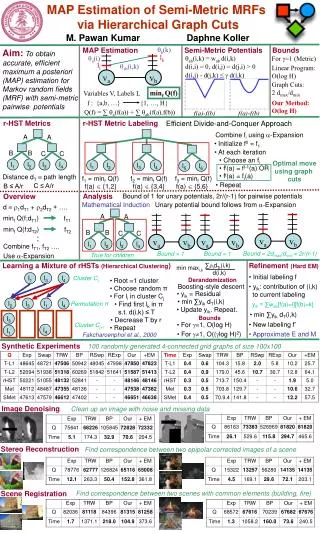
MAP Estimation of Semi-Metric MRFs via Hierarchical Graph Cuts M. Pawan Kumar Daphne Koller MAP Estimation b(k) Semi-Metric Potentials Bounds Aim:To obtain accurate, efficient maximum a posteriori (MAP) estimation for Markov random fields (MRF) with semi-metric pairwise potentials lk a(i) ab(i,k) = wab d(i,k) For =1 (Metric) li ab(i,k) d(i,i) = 0, d(i,j) = d(j,i) > 0 Linear Program: O(log H) va vb d(i,j) - d(j,k) ≤ d(i,k) Graph Cuts: 2 dmax/dmin minf Q(f) Variables V, Labels L f : {a,b, …} {1, …, H} Our Method: O(log H) Q(f) = ∑ a(f(a)) + ∑ ab(f(a),f(b)) f(a)-f(b) f(a)-f(b) r-HST Metrics r-HST Metric Labeling Efficient Divide-and-Conquer Approach Combine fi using -Expansion A A • Initialize f0 = f1 • At each iteration • Choose an fi • ft(a) = ft-1(a) OR • ft(a) = fi(a) B B C C Optimal move using graph cuts l1 l2 l3 l4 l1 l2 l3 l4 l5 l6 Distance dT path length f1 = minf Q(f) f2 = minf Q(f) f3 = minf Q(f) • Repeat C ≤ A/r B ≤ A/r f(a) {1,2} f(a) {3,4} f(a) {5,6} Analysis Overview Bound of 1 for unary potentials, 2r/(r-1) for pairwise potentials Mathematical Induction Unary potential bound follows from -Expansion d 1dT1 + 2dT2 + …. A A minfQ(f;dT1) fT1 minfQ(f;dT2) fT2 B B . C C . va vb va vb va vb l1 l2 l3 l4 Combine fT1, fT2 …. Bound = 2dmax/dmin = 2r/(r-1) Bound = 1 Bound = 1 True for children Use -Expansion Learning a Mixture of rHSTs (Hierarchical Clustering) Refinement (Hard EM) ∑tdTt(i,k) min maxi,k d(i,k) • Initial labeling f l1 l3 l4 Cluster Cj Derandomization • Root 1 cluster Boosting-style descent • yik: contribution of (i,k) • to current labeling • Choose random π • yik = Residual • For li in cluster Cj • Find first lk in π • s.t. d(i,k) ≤ T • min ∑yik dT(i,k) l2 l3 l1 l4 Permutation π yik = ∑wab[f(a)=i][f(b)=k] • Update yik. Repeat. • min ∑yik dT(i,k) l3 Bounds • Decrease T by r • New labeling f’ • For =1, O(log H) Cluster Cj+1 • Repeat l4 l1 • For 1, O((log H)2) • Approximate E and M Fakcharoenphol et al., 2000 Synthetic Experiments 100 randomly generated 4-connected grid graphs of size 100x100 Image Denoising Clean up an image with noise and missing data Stereo Reconstruction Find correspondence between two epipolar corrected images of a scene Scene Registration Find correspondence between two scenes with common elements (building, fire)