Understanding Photosynthesis: The Light Reactions and Calvin Cycle
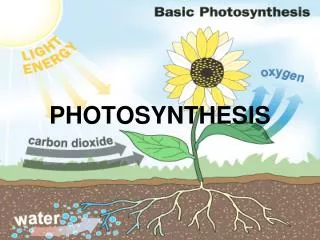
Photosynthesis occurs in two main stages: the Light Reactions and the Calvin Cycle, both taking place in chloroplasts. The Light Reactions convert light energy and water into ATP, NADPH, and oxygen. The Calvin Cycle utilizes CO2 to synthesize glucose using the ATP and NADPH produced in the Light Reactions. Key molecules involved include chlorophyll, which absorbs light, and Rubisco, the enzyme that fixes carbon dioxide. This process is crucial for plant energy production and supports life on Earth by converting solar energy into chemical energy.

Understanding Photosynthesis: The Light Reactions and Calvin Cycle
E N D
Presentation Transcript
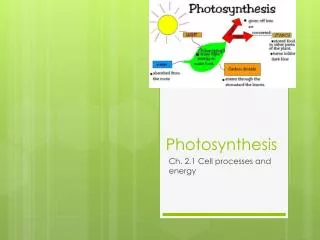
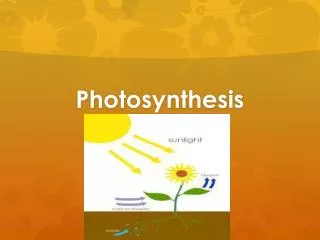
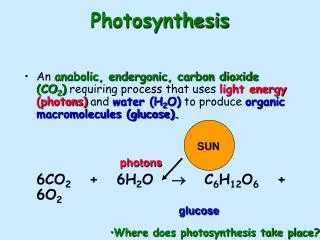
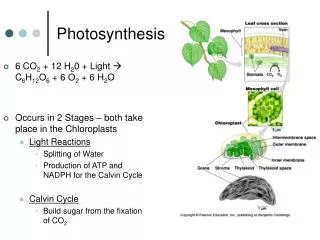
Photosynthesis • 6 CO2 + 12 H20 + Light C6H12O6 + 6 O2 + 6 H2O • Occurs in 2 Stages – both take place in the Chloroplasts • Light Reactions • Splitting of Water • Production of ATP and NADPH for the Calvin Cycle • Calvin Cycle • Build sugar from the fixation of CO2
Light Reactions: Light and Water produce oxygen gas • ATP and NADPH at made by electron transport chains • Calvin Cycle: CO2 is used to build sugar • ATP and NADPH are USED to build the sugar • The Light reactions fuel the Calvin Cycle with ATP and NADPH
IClicker • Do plants use mitochondria for cellular respiration? • A – Yes • B - No
Light • The electromagnetic spectrum contains EMWs of different wavelengths and energy levels • Light is composed of energy containing photons • Photons can be absorbed by molecules altering their energy or conformation • Some photon receptors are proteins
Leaves are green because Chloroplasts REFLECT the green light. • Pigments in chloroplasts absorb the photons from specific wavelengths • Chlorophyll a • Violet/blue and red • Chlorophyll b • Blue and orange/red • Carotenoids • Violet and blue/green
Experimental evidence demonstrating that green light is NOT absorbed by chloroplasts • Blue light IS absorbed • Spectrophotometer measures beams of light of a given wavelength through a solution.
Chlorophyll is a pigment • Chlorophyll is NOT a protein • It is a molecule of the class: Porphyrin
The light energy absorbed by a chlorophyll molecule can be released in the form of photons • OR • Utilized by a neighboring molecule
Chloroplasts use Photosystems to harness the energy from light • Photons (a form of energy) are absorbed and that energy is used to transfer electrons and to split a molecule of water • Water –(light and an enzyme) oxygen atom + 2 electrons + 2 protons
IClicker • 5) What does the chemiosmotic process in chloroplasts involve? • A) formation of glucose, using carbon dioxide, NADPH, and ATP • B) diffusion of electrons through the thylakoid membrane • C) establishment of a proton gradient • D) reduction of water to produce ATP energy • E) movement of water by osmosis into the thylakoid space from the stroma
IClicker • 6) Which of the following are products of the light reactions of photosynthesis that are utilized in the Calvin cycle? • A) H2O and O2 • B) ADP, Pi, and NADP+ • C) ATP and NADPH • D) electrons and H+ • E) CO2 and glucose
IClicker • A plant has a unique photosynthetic pigment. The leaves of this plant appear to be blue and purple. What wavelengths of visible light are not being absorbed by this pigment? • A) blue and purple • B) green, blue, and violet • C) blue, green, and red • D) green and yellow • E) red and yellow
Photosystems • Complexes of Proteins and Pigments embedded through membrane within the chloroplast pigments protein protein: Primary electron acceptor e-
Light Reactions – 2 photosystems • Photosystem II (P680) • Primarily uses light of wavelength 680 • Transfers electrons to an Electron Transport Chain that converts ADP to ATP • Photosystem I (P700) • Primarily uses light of wavelength 700 • Transfers electrons to an Electron Transport Chain that converts NADP+ to NADPH
The mechanism of ATP production is analogous to the mechanism in Mitochondria - CHEMIOSMOSIS
The Calvin Cycle uses MORE ATP than NADPH • LINEAR (NON cyclic) electron flow • Uses PS II and I • Uses 2 electron transport chains to produce • ATP • NADPH • CYCLIC electron flow • Only uses PS I (P700) • Uses 1 electron transport chain to produce • Additional ATP
Chemiosmosis • Mechanism of production of ATP relies on a concentration gradient of Hydrogen ions (H+) • Diffusion through ATP synthase catalyzes the reaction of ADP with Pi to form ATP
IClicker • 4) What does cyclic electron flow in the chloroplast produce? • A) glucose • B) NADPH • C) ATP • D) A and B • E) A, B, and C
IClicker • 3) What are the products of noncyclic photophosphorylation? • A) ATP and P700 • B) ATP and NADPH • C) P700 and P680 • D) ADP and NADP • E) heat and fluorescence
Calvin Cycle • Cyclic series of biochemical reactions • Rubisco is the enzyme that catalyzes the fixation of Carbon Dioxide to RuBP • RuBP is regenerated • A 3 carbon sugar results from the calvin cycle which is used to build glucose for cellular respiration
IClicker • All of the events listed below occur in the light reactions of photosynthesis except • A – oxygen is produced • B – NADP+ is reduced to NADPH • C – carbon dioxide is incorporated by Rubisco • D – ADP is phosphorylated to yield ATP • E – light is absorbed and funneled to reaction centers
IClicker • Which of the following statements best represents the relationships between the light reactions and the Calvin Cycle? • A - The light reactions provide ATP and NADPH to the Calvin cycle, and the cycle returns ADP, Pi, and NADP+ to the light reactions. • B - The light reactions provide ATP and NADPH to the carbon fixation step of the Calvin cycle, and the cycle provides water and electrons to the light reactions. • C - The light reactions supply the Calvin cycle with CO2 to produce sugars, and the Calvin cycle supplies the light reactions with sugars to produce ATP. • D - The light reactions provide the Calvin cycle with oxygen for electron flow, and the Calvin cycle provides the light reactions with water to split. • E - There is no relationship between the light reactions and the Calvin cycle.