Understanding the Pronouns "En" and "Y" in French Grammar
80 likes | 214 Vues
This guide explains how to use the French pronouns "en" and "y" effectively in sentences. "En" replaces phrases that translate to "some," "any," or "of it," and is used before conjugated verbs or infinitives. It can substitute nouns following "un," "une," numbers, or quantity expressions. Additionally, you'll learn to combine "en" and "y" with other object pronouns and explore contraction forms with "à" and "de." Mastering these components will enhance your French fluency.


Understanding the Pronouns "En" and "Y" in French Grammar
E N D
Presentation Transcript
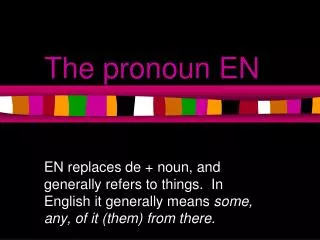
The pronoun en En translates to some, any, of it, or of them.
You can replace a form of de + noun with en. Tuveuxdu yaourt? Non, merci, je n’enveux pas.
En can also replace nouns that follow un, une, numbers, or expressions of quantity. In this case, you normally still use un, une, the nubmer, or the expression of quantity in the sentence with en. • Tumangesbeaucoup de sandwiches? • Oui, j’en mange beaucoup. • J’enprendssouventun à midi. • Moi, j’enprendssouventdeux!
Place en before the infinitive in the sentence if there is one. Otherwise, place it before the conjugated verb. • Des crevettes? • Oui, j’enveux un kilo. • Je vaisen faire cuirecesoir.
You have learned that if you have a sentence with both direct and indirect object pronouns, you place the pronoun in a certain order. You can also combine the pronouns y and en with the object pronouns you have learned. Notice the position of these pronouns when used with other object pronouns.
Place pronouns before the conjugated verb in a sentence or in front of the infinitive. This is also true when you use more than one pronoun at a time. Tupeuxmedonnerdes fraises? Bien sur, je t’endonne. Vousachetezles baguettes à la boulangerie? Oui, je les y achète.
Y and en can be used together in the same sentence, although it is not common. They are used together with the following expression. Il y a des cerises au marché? Oui, ily en a. Are there any cherries at the market? Yes, there are (some there).
Contractions with à and deRemember how to form contractions with à and de? Here are the forms. à à + le = au à + la = àla à + l’ = àl’ à + les = aux Je vaisàl’épiceriedu quartierouàl’hypermarchéau coin de la rue. de de + le = du de + la = de la de + l’ = de l’ de + les = des