Understanding Simple Machines: Types and Examples Explained
Simple machines are basic mechanical devices that ease work by reducing effort and modifying force direction. They have few or no moving parts and include six primary types: inclined plane, wedge, screw, lever, pulley, and wheel and axle. Each type has unique applications: an inclined plane includes ramps and stairs; wedges like knives and axes split objects; screws are used in tools and fasteners; levers help lift heavy loads; pulleys change force direction in cranes; the wheel and axle appear in various everyday items. Together, these machines form the foundation for complex machinery.

Understanding Simple Machines: Types and Examples Explained
E N D
Presentation Transcript
What is a simple machine? • It has few or no moving parts. • It makes work easier.
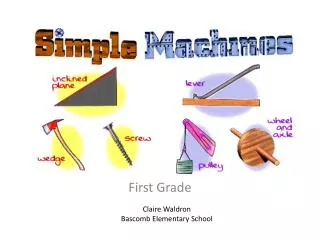
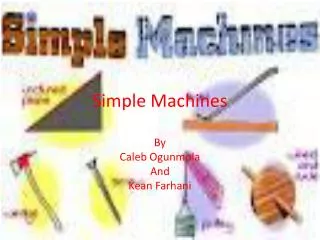
Types of Simple Machines • Inclined Plane • Wedge • Screw • Lever • Pulley • Wheel and Axle
Inclined Plane – a slanted surface to make lifting easier. Examples: Boat Ramp, Bottom of a bath tub, Stairs, Ladder
Wedge – two inclined planes together, back to back. Usually used to split an object. Examples: knife, ax, zipper, door wedge
Screw – the combination of a wedge at the bottom and an inclined plane around it. Examples: drill bits, screws
Lever – most things with a handle attached; used to lift heavy objects; fulcrum Examples: Seesaw, Crowbar, Rake
Pulley – a wheel with a groove running around it with a rope, cable or chain to change the direction of a force, usually gravity Examples: fishing reel, crane, flag pole, clothes line
Wheel and Axle – a rod or post secured to a wheel Examples: Steering Wheel, Wheel Barrel, Faucet Handle, Door Knob, Fan, Screw Driver
Simple machines can be used together to make complex machinery.