Molecular Activation on Hot Surfaces: Insights from First Principles Calculations
200 likes | 321 Vues
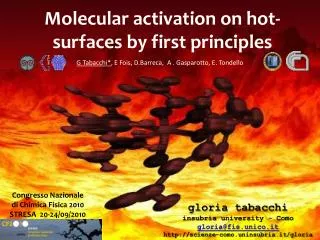
This study explores the activation of molecular precursors on heated substrates, focusing on the Chemical Vapor Deposition (CVD) process. We investigate Cu(hfa)2·TMEDA precursor activation at temperatures of 750 K on a hydroxylated SiO2 surface. Using first principles molecular dynamics simulations, we demonstrate the key role of surface/molecule energy transfer in triggering molecular activation through fast rolling diffusion. Our findings reveal novel phenomena that impact the formation of organized nanostructures and highlight the complex interactions occurring at high temperatures.


Molecular Activation on Hot Surfaces: Insights from First Principles Calculations
E N D
Presentation Transcript
G Tabacchi*, E Fois, D.Barreca, A . Gasparotto, E. Tondello Molecular activation on hot-surfaces by first principles gloria tabacchi insubriauniversity - Como gloria@fis.unico.it http://scienze-como.uninsubria.it/gloria Congresso Nazionale di Chimica Fisica 2010 STRESA 20-24/09/2010
Molecules @ hot surfaces: ac ……may lead to organized nanostructures (not achievable at mild conditions) …through alternative and unexpectedpathways
For example, on MgO at T≈400 K..e Ru3 + Os3 clusters Ru–Os clusters A. Kulkarni, B. C. Gates, Angew. Chem. Int. Ed. 2009, 48, 9697. togetRu-Os, desorption and migrationof Os3/Ru3clustersmust take place. How?
The Chemical Vapor Deposition (CVD) process M Molecularprecursor Metal oxides
CuxO (x=1,2) nanosystems Continuousfilms CuIIprecursor HEATED SUBSTRATE N CuII Quasi-1D nanosystems O1 CVD O2 T=523-823K Gas sensing Cu (hfa)2 tmeda (Hhfa = 1,1,1,5,5,5-hexafluoro-2,4-pentanedionate; TMEDA = N,N,N’,N’-tetramethyl-ethylendiamine) Ts[Cu(hfa)2(TMEDA)] = 343 K H2 production A PCCP2009, 11, 5998
450°C 450°C 100 nm 200 nm 550°C 550°C …toCuO 1D nanoarchitectures (NWs) 1 μm 200 nm From Cu2O granular films… 400°C 400°C 200 nm 100 nm dry O2 atmosphere 500°C 500°C 200 nm 100 nm Cryst. Growth Des.2009, 9, 2470
By CVD processes /advancedexperimentaltechniques… we can: we can not: know how molecules are converted into materials: Precursor Activation on the heated substrate Precursor decomposition (liberation of the metal centre through ligand elimination) MOx formation mechanism • grownanostructuresfrommolecularprecursors • controltheirphasecomposition and morphology • exploit theirfunctionalproperties
This work Modeling the first stages of the CVD process: activation of the Cu(hfa)2TMEDA precursor on a hot substrate (T = 750 K) • Substrate surface @ CVD-conditions: hydroxylated SiO2 • Model surface: 1 nm thick SiO2 slab with 2.8 Si-OH groups /nm2 Problem: the Cu center is protected by the ligands!
Physisorption, rolling diffusion & molecular activation Three different regimes: a) Slow diffusion;b) physisorption;c) fast diffusion by rolling Mean square displacement in-plane (x,y) trajectory b Å Å
30 ps first principles molecular dynamics simulation of the Complex/Surface system at T=750 K • Substrate surface @ CVD-conditions: hydroxylated SiO2 • Model surface: 1 nm thick SiO2 slab with 2.8 Si-OH groups /nm2
Key role of the surface/molecule energy transfer in the complex activation Physisorption: Close contacts with the hot surface favor energy transfer to the molecule • Fast Rolling diffusion: • Largedeformations • interligandinteractions • @ 750 K, kT/hc = 550 cm-1 • Cu-Ligand bond stretching frequencies < 600 cm-1
..A vibrationally excited complex rolling on a hot surface may do this…
Or this: …..Or ? … and then?
conclusions Fast rolling diffusion regime: • Stems from surface-molecule energy transfer • Triggers molecular activation • May be a general feature of high temperature surface chemistry A novel phenomenon, many open questions ….
Acknowledgements • MIUR PRIN 2007 project “ Microscopic features of chemical reactivity” • CNR-INSTM PROMO • CARIPARO Foundation within the project “Multi-layer optical devices based on inorganic and hybrid materials by innovative synthetic strategies”
Cu2O O2 + H2O atmosphere CuO
Main peaks assignment (cm-1): 2800-3300: (C-H); 1674: (C=O); 1400-1560: (C=C), (C-H) + (CH3)/(CH2) 1140-1260: combination of (C-H), (C-CF3), (C-F) 576: (Cu-Oeq.); 319 (Cu-Oap.); 490: (Cu-N) U-B3LYP/Cu: ECP10-MDF/aug-cc-pVDZ-PP; Ligands: D95+*level of computation G. Bandoliet al. PCCP, 2009, 11, 5998. vibrational spectra of the isolated Cu(hfa)2 tmeda complex