Precip Type Forecasting – The Top Down Method
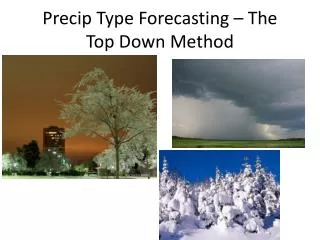
Precip Type Forecasting – The Top Down Method. Top down approach uses soundings to forecast precip type. Four Steps: 1. Is there ice in the cloud? 2. Consider dry layers. 3. Consider warm layers. 4. Consider near surface conditions. Is There Ice in the Cloud?. Start at top of sounding

Precip Type Forecasting – The Top Down Method
E N D
Presentation Transcript
Top down approach uses soundings to forecast precip type. • Four Steps: • 1. Is there ice in the cloud? • 2. Consider dry layers. • 3. Consider warm layers. • 4. Consider near surface conditions.
Is There Ice in the Cloud? • Start at top of sounding • Find first cloud layer • Determine temperature at this cloud layer • Coldest temperature
Consider the Dry Layers • Will the precip particle evaporate? • Will temperature cool to the wet bulb temperature? • If so, the layer will become saturated. • Is there a seeder feeder situation? • 2 cloud layers, one with ice • Ice does not evaporate and falls into lower cloud • Whole cloud layer eventually contains ice
Seeder Feeder
Dry Layer Probably does not evaporate
Consider the Warm Layers • If there is no warm layer, ice continues to fall • If there is, must determine if ice will melt • Keep wet bulb temp in mind • Layer will cool if precip is falling • If ice is falling:
Warm Layer Ice completely melts
Warm layer Ice does not melt
Lastly, Look Near the Surface • Does precip re-freeze, continue to melt, freeze on contact, etc. If ice is falling: If mix is falling:
If super cooled water is falling: Basically, look at depth and temp of near surface cold layer and surface wet bulb temperature. There are always exceptions!