Psychology 291 Behavior Modification Basics
110 likes | 227 Vues
This guide explores the foundational aspects of behavior modification, emphasizing the importance of learning types, including explicit and tacit knowledge. It discusses key constructs like antecedents, behavior, and consequences, as well as reinforcement schedules that shape behavior over time. The role of feedback in learning is examined, highlighting the value of 360-degree feedback and the significance of source credibility. Additionally, it covers Social Learning Theory and self-directed learning, illustrating how these concepts contribute to effective skill development in various settings.


Psychology 291 Behavior Modification Basics
E N D
Presentation Transcript
Psychology 291 Behavior Modification Basics
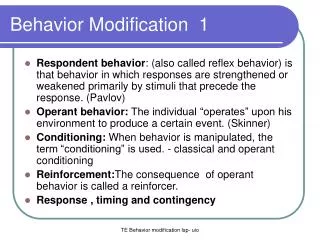
Building blocks of learning • Behavior mod requires learning • Knowledge types: • Explicit (declarative) knowledge • Tacit (procedural) knowledge • Generally must learn facts (the what) before you can learn how to apply them (the how)
Key Constructs in Behavior Modification • Antecedents • What leads to the behavior? • Behavior • Consequences • Positive reinforcement • Negative reinforcement • Punishment
Reinforcement Schedules • Continuous – one behavior, one consequence • Intermittent • Fixed Interval • Variable Interval • Fixed Ratio • Variable Ratio Amount of time Number of behaviors
What happens when reinforcement is removed? • Ideally, people have learned the behavior and it will continue over time • Not always the case -- field study on safety behaviors (Komaki, Barwick & Scott, 1978)
Learning Through Feedback • What is feedback? • What are good sources of feedback? • Feedback is most useful for learning when it contains information about what to correct
360 Degree Feedback • Getting feedback from multiple sources around you • Provides a more complete picture – no one source has all the information • Challenges • Variation in feedback • Comfort in providing feedback • Administrative and practical issues (e.g., time)
Feedback contingencies • All feedback is not equal • Source credibility: People evaluate the credibility of the feedback source before deciding what actions to take (Podsakoff & Fahr, 1987) • Can I trust this person? • Is this person knowledgeable? • Feedback can be distracting • Negative feedback can cause people to direct attention to themselves (e.g., impression management) Feedback Intervention Theory, Kluger & DiNisi, 1996)
Social Learning Theory • Much learning occurs by observing others • Especially tacit knowledge • Model positive behaviors, avoid negative behaviors • Helps maintain self-esteem (don’t have to ask as many questions) • Can be problems with interpretation of behaviors
Self-Directed Learning • Learner makes own choices regarding many aspects of the learning process • When and how long • Where • In what order • Critical as learning becomes decentralized • Often the case with computer-based training • Novices often don’t know how best to approach the learning task
Key learning points • Behavior modification relies on pairing of response and reinforcement • Most effective feedback provides direction for learning • Self-directed learning becoming more important in organizations • Can monitor own learning patterns to improve effectiveness