Understanding K-means Clustering: Centroid Weights and Buffer Management
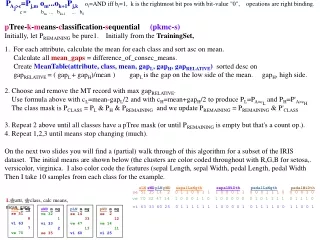
This guide explores the K-means clustering algorithm, focusing on the management of centroids within buffers. Each data vector affects the centroid's weight and location, influencing clustering accuracy. As more data is processed, centroids require adjustments, particularly those with higher weights, to maintain effective clustering. This document breaks down the mechanics of centroids and their interaction with buffers, providing clear examples of their properties and behavior to enhance your understanding of K-means.


Understanding K-means Clustering: Centroid Weights and Buffer Management
E N D
Presentation Transcript
E 6 C D F 5 6 A B 1 5 2 4 5 1 8 c3 1 c1 c2 2 4 5 1 8 (1/4) K-means example Buffer New centroidpropertiesareneeded: ”Weight” and ”location” Eachdatavectordiscardedfrombufferwillincreaseit’slastpartitioncentroid’s ’weight’ Buffer The more the centroidweights, the moreitrequirepulling to move
c3 E E c3 F C c2 c2 F D C D c1 c1 6 6 A A B B 5 5 1 1 2 2 4 4 5 5 1 1 8 8 (2/4) K-means example Buffer Buffer
6 5 c3 c3 6 1 c2 c2 5 2 1 4 5 8 c1 c1 1 2 4 5 1 8 (3/4) K-means example Starts to pull the ”heavy” Weightedcentroid! Buffer Buffer
E c3 c2 F C D c1 6 A B 5 1 2 4 5 1 8 (4/4) K-means example Buffer