Download
1 / 1
20 likes | 134 Vues
Dhrupad is a profound form of Indian classical music aimed at inducing deep feelings of peace and contemplation rather than mere entertainment. Comprising three key components—Alaap, Jor-Jhala, and Composition—Dhrupad emphasizes purity and clarity of notes, with Alaap exploring ragas note by note. The Jor introduces a steady yet non-cyclical beat, showcasing the raga's personality, while compositions are performed with the pakhawaj, often set to intricate rhythmic cycles. Each element invites listeners to experience the transcendental beauty of sound.

E N D
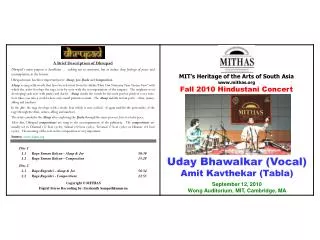
A Brief Description of Dhrupad Dhrupad’s main purpose is Aradhana … seeking not to entertain, but to induce deep feelings of peace and contemplation in the listener. Dhrupad music has three important parts: Alaap, Jor-Jhala and Composition. Alaap is sung with words that have been derived from the shloka “Hari Om Narayana Taan Tarana Tum” with which the artist develops the raga, note-by-note with the accompaniment of the tanpura. The emphasis is on developing each note with purity and clarity. Alaap entails the search for the most perfect pitch of every note. So it takes you into a world where only sound patterns remain. The Alaap unfolds in four parts – sthai, antara, abhog and sanchari. In the Jor, the raga develops with a steady beat which is non-cyclical. It again unfolds the personality of the rage through the sthai, antara, abhog and sanchari. The artist concludes the Alaap after exploring the Jhala through the same process, but at a faster pace. After this, Dhrupad compositions are sung to the accompaniment of the pakhawaj. The compositions are usually set in Chautaal (12 beat cycle), Sultaal (10 beat cycle), Tivrataal (7 beat cycle) or Dhamar (14 beat cycle). The meaning of the text in the composition is very important. Source: www.dagar.org MIT’s Heritage of the Arts of South Asia www.mithas.org Fall 2010 Hindustani Concert Uday Bhawalkar(Vocal) Amit Kavthekar (Tabla) September 12, 2010 Wong Auditorium, MIT, Cambridge, MA