Download
1 / 24
260 likes | 384 Vues
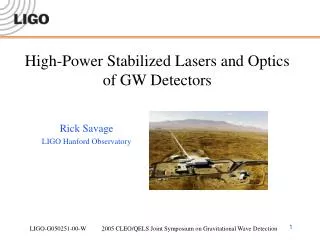
This article discusses the significant advancements in gravitational wave (GW) detector technology, focusing on the LIGO detectors. It reviews noise reduction methods, enhanced sensitivity, and calibration techniques that have improved detection capabilities. Key features include the transition from Initial to Advanced LIGO, employing advanced optics and powerful lasers, and seismic isolation enhancements. The article also highlights the importance of the antenna pattern and free spectral range in high-frequency sensitivity, contributing to multi-detector networks like Advanced LIGO, Advanced Virgo, and KAGRA.

E N D
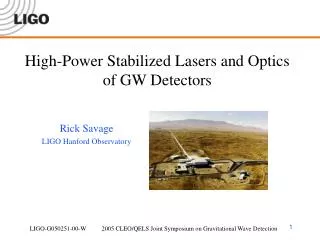
LIGO detectors Rep. Prog. Phys. 72 (2009) 076901arXiv:0711.3041
“Antenna pattern” “peanut”
LIGO high frequency sensitivity “FSR” (free spectral range) 37.5 kHz Class. Quantum Grav. 25 (2008) 184017
LIGO calibration Nucl. Instrum. Meth. A624 (2010) 223arXiv:1007.3973
Advanced LIGO/ Advanced Virgo ~10 times better, lower frequencies in band Installation in progress
Initial vs Advanced LIGO Simple pendulums become monolithic, quadruple pendulumswith better quality optics Prototypes being tested, optics are polished
Initial vs Advanced LIGO Lasers become more powerful: 10W 200 W Installed and being tested at LIGO Livingston.
Initial vs Advanced LIGO Seismic isolation goes from passive to active HAM SEI tested in S6 Most chambers have now their “SEI” installed.
The Advanced GW Detector Network~2020 Advanced LIGO Hanford GEO600 Advanced Virgo KAGRA Advanced LIGO Livingston LIGO-India? 19
Pulsar timing arrays Image Courtesy of Michael Kramer Nanograv residuals
Online generators http://www.srl.caltech.edu/~shane/sensitivity/MakeCurve.html http://www.gwoptics.org/processing/space_time_quest/