Download
1 / 6
60 likes | 180 Vues
Dive into the fundamental principles of gravity acceleration and relative velocities in this educational guide. Learn about the constant acceleration due to gravity, scenarios involving tossed or dropped balls, and how to calculate changes in velocity over time intervals in physics.

E N D
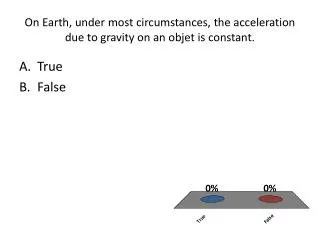
On Earth, under most circumstances, the acceleration due to gravity on an objet is constant. • True • False
A ball is tossed straight up in the air. Once the ball leaves your hand, when is acceleration negative? (Assume the origin is you) • While the ball is moving upwards • While the ball is moving downwards • Never during its journey • During its entire journey
A ball is dropped with no initial velocity. After t seconds, the ball has velocity v. What is the increase in the velocity of the ball from t seconds to 2t seconds? • v • 2v • v/2 • Not enough information
va/c = va/?+vr/c • a • b • c • r
Two objects traveling towards each other will have ______ relative velocities. • The same • Equal in magnitude and opposite in direction • Completely differing • Equal in direction and differing magnitude
Two objects traveling towards each other at 0.75c have relative velocities of magnitude 1.5c. • True • False