Understanding Population Dynamics: Factors Influencing Growth and Evolution
This comprehensive overview delves into the dynamics of population size, highlighting the crucial roles of natality (birth), immigration, mortality (death), and emigration (movement out). It defines population as a group of organisms of the same species in a specific area. The text further explains the phases of population growth, contrasting exponential growth with the logistic model, and illustrates the S-shaped growth curve. Additionally, it outlines limiting factors that restrict population increase, fostering an understanding of species' carrying capacity and environmental constraints.

Understanding Population Dynamics: Factors Influencing Growth and Evolution
E N D
Presentation Transcript
Population Dynamics And Evidence for Evolution
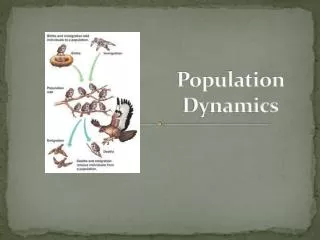
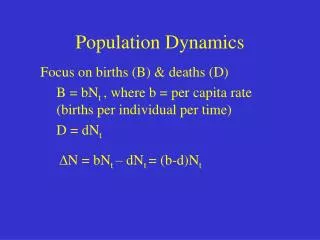
Outline how population size is affected by natality, immigration, mortality and emigration • Population – a group of organisms of the same species living in the same area at the same time • Ways population size can change: • Natality • Mortality • Immigration • Emigration • Pop Change = (N+I) – (M + E)
Draw and label a graph showing a sigmoid (S-shaped) population growth curve • Do it. Now!
Draw and label a graph showing a sigmoid (S-shaped) population growth curve • Exponential vs. Logistic (Exponential) Growth
Explain reasons for the exponential growth phase, the plateau phase, and the transitional phase between these two phases • During the Exponential phase the population increases exponentially because the natality rate is higher than the mortality rate. The resources needed by the population such as food and space are abundant, and diseases and predators are low. • During the Transitional Phase, the birth rate begins to decrease. Natality is still larger than mortality, but the difference between them is slowly decreasing. • During the Plateau phase, available resources become so low that no further growth can take place. Mortality starts to become larger than natality. A species may have reached its Carrying Capacity (K).
List 3 factors that set limits to population increase • 1. • 2. • 3.