Initiating Change in Biology Curriculum: University of Oregon Case Study
This study explores the implementation of a new early course focused on quantitative biology through a department retreat, participation in an ad hoc committee, and addressing barriers such as faculty familiarity and prerequisite courses. The goal is to align curriculum with Vision and Change principles.

Initiating Change in Biology Curriculum: University of Oregon Case Study
E N D
Presentation Transcript
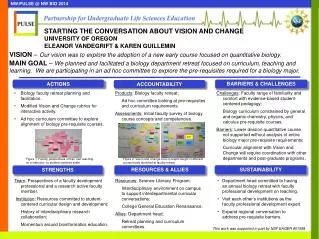
NW-PULSE @ NW BIO 2014 STARTING THE CONVERSATION ABOUT VISION AND CHANGE UNIVERSITY OF OREGON ELEANOR VANDEGRIFT & KAREN GUILLEMIN VISION – Our vision was to explore the adoption of a new early course focused on quantitative biology. MAIN GOAL – We planned and facilitated a biology department retreat focused on curriculum, teaching and learning. We are participating in an ad hoc committee to explore the pre-requisites required for a biology major. BARRIERS & CHALLENGES ACTIONS ACCOUNTABILITY • Biology faculty retreat planning and facilitation. • Modified Vision and Change rubrics for interactive activity. • Ad hoc curriculum committee to explore alignment of biology pre-requisite courses. Products: Biology faculty retreat; Ad hoc committee looking at pre-requisites and curriculum requirements. Assessments: Initial faculty survey of biology course concepts and competencies. Challenges: Faculty range of familiarity and comfort with evidence-based student-centered pedagogy; Biology curriculum constrained by general and organic chemistry, physics, and calculus pre-requisite courses. Barriers: Lower division quantitative course not supported without analysis of entire biology major pre-requisite requirements; Curricular alignment with Vision and Change will require coordination with other departments and post-graduate programs. 100 200 300 400 Figure 1. Faculty perspectives of their own teaching on a instructor- to student-centered scale. Figure 2. Vision and Change core concepts taught in different course levels identified at faculty retreat. SUSTAINABILITY RESOURCES & ALLIES STRENGTHS Team: Perspectives of a faculty development professional and a research active faculty member. Institution: Resources committed to student-centered curricular design and development; History of interdisciplinary research collaboration; Momentum around bioinformatics education. Resources: Science Literacy Program; Interdisciplinary environment on campus to support interdepartmental curricular conversations; College General Education Renaissance. Allies: Department head; Retreat planning and curriculum committees. • Department head committed to having an annual biology retreat with faculty professional development on teaching. • Visit each other’s institutions as the faculty professional development expert. • Expand regional conversation to address pre-requisite barriers. This work was supported in part by NSF EAGER #51588