Download
1 / 3
30 likes | 152 Vues
This paper explores the critical issue of user migration patterns in social media, highlighting how and where users move between platforms. It discusses the inevitability of migration and its implications for site revenues, with new sites striving to attract users and old ones focusing on retention. The study identifies two types of migration: site migration and attention migration, based on longitudinal analysis over three months across seven different social media sites. It validates migration patterns through hypothesis testing, contributing significant insights that can inform strategies to track high net-worth individuals in the social media landscape.

E N D
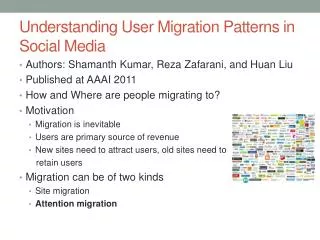
Understanding User Migration Patterns in Social Media • Authors: Shamanth Kumar, Reza Zafarani, and Huan Liu • Published at AAAI 2011 • How and Where are people migrating to? • Motivation • Migration is inevitable • Users are primary source of revenue • New sites need to attract users, old sites need to retain users • Migration can be of two kinds • Site migration • Attention migration
Our Findings • Attention Migration • Occurs when a user becomes inactive on a site • Can be studied through user activity to prevent permanent migration • Contributions • Longitudinal study across 3 months on 7 social media sites. • One of the first studies on user migration in social media • Established migration patterns between social media sites • Validated patterns via hypothesis testing. • Demonstrated that these patterns can be capitalized by tracking High Net-Worth Individuals (HNWI) After time t
Validating User Migration Patterns in Social Media • Problem: • Migration is inevitable • What are the migration patterns in social media? • How do we distinguish observed migration patterns from random patterns? • Evaluation Strategy: • Generate Shuffled datasets by randomly picking users from at-risk population • Compare trends in the observed and shuffled datasets • Coefficients of user attributes • Shuffled datasets Logistic Regression • Significance Test Chi Square Statistic • Coefficients of user attributes • Observed migration dataset Logistic Regression