Download
1 / 14
150 likes | 293 Vues
Thermochemistry explores the relationship between chemical reactions and energy changes related to heat. It examines two types of energy: potential energy, associated with an object's position, and kinetic energy, related to motion. Energy units include Joules and calories. The first law of thermodynamics states that energy is conserved (ΔE = q + w). Processes can be classified as endothermic (heat absorbed) or exothermic (heat released). Learn how to calculate energy changes in various thermodynamic scenarios, using specific heat and heat transfer concepts.

E N D
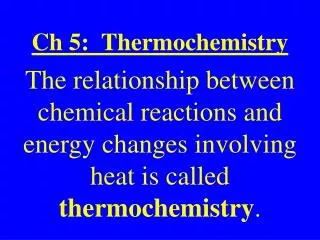
Ch 5: Thermochemistry The relationship between chemical reactions and energy changes involving heat is called thermochemistry.
Types of Energy Potential energy: energy objects posses as a result to position to other objects Kinetic energy: energy posses by virtue of motion (E=1/2mv2)
Units of Energy Joule = 1kg-m2/s2 1 calorie = 4.184 J 1 Cal = 1000 cal = 1 kcal
System: the focus of study Surroundings: everything else
Energy used to cause an object to move against a force is called work. W = F x d
Heat is the energy transferred from a hotter object to a colder one.(q) Energy is the capacity to do work or transfer heat.(E)
First law of thermodynamics Energy is conserved. E = Efinal - Einitial
E = q + w Anytime work or heat acts on the system it is a positive value. (Vice-versa)
When a process occurs in which the system absorbs heat, it is called endothermic. A process in which the system evolves heat is called exothermic.
Calculate E The system absorbs 77.5 kJ of heat while doing 63.5 kJ of work on the surroundings.
E = 14 kJ Endothermic
How to solve for q q = mct c = the specific heat of the material. H2O = 4.18 J/gK
If a 3.0 g metal is heated to 95oC and added to a cup of water (50g) at 23oC, and the water raises to 30oC, what is the specific heat of the metal?
If 125 mL of water at 88oC is added to 50 mL of water at 30oC, what is the new temperature of the water?