Understanding Chemical Formulas, Subscripts, and Mineral Stoichiometry: A Comprehensive Overview
This article delves into the fundamentals of chemical formulas and subscripts, which denote the relative quantities of elements in minerals. It explores the concept of solid solutions where elements, such as Mg and Fe, can substitute for each other, creating a variety of mineral compositions. Key examples include the olivine group and pyroxene solid solutions. Additionally, the normalization technique for converting element weight percentages to oxide weights and moles is discussed, providing a clearer understanding of mineral composition and analysis.

Understanding Chemical Formulas, Subscripts, and Mineral Stoichiometry: A Comprehensive Overview
E N D
Presentation Transcript
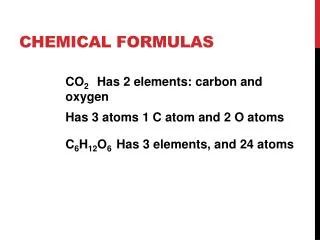
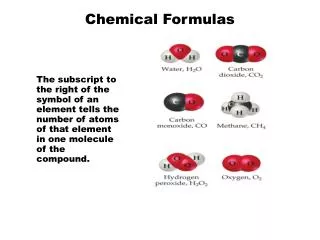
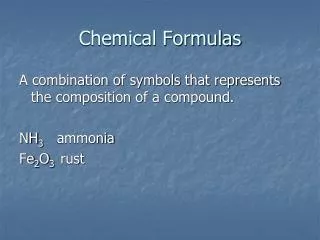
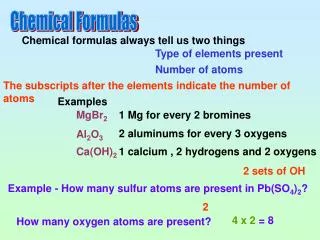
Chemical Formulas • Subscripts represent relative numbers of elements present • (Parentheses) separate complexes or substituted elements • Fe(OH)3 – Fe bonded to 3 separate OH groups • (Mg, Fe)SiO4 – Olivine group – mineral composed of 0-100 % of Mg, 100-Mg% Fe
Stoichiometry • Some minerals contain varying amounts of 2+ elements which substitute for each other • Solid solution – elements substitute in the mineral structure on a sliding scale, defined in terms of the end members – species which contain 100% of one of the elements
Chemical heterogeneity • Matrix containing ions a mineral forms in contains many different ions/elements – sometimes they get into the mineral • Ease with which they do this: • Solid solution: ions which substitute easily form a series of minerals with varying compositions (olivine series how easily Mg (forsterite) and Fe (fayalite) swap…) • Impurity defect: ions of lower quantity or that have a harder time swapping get into the structure
Compositional diagrams Fe3O4 magnetite Fe2O3 hematite FeO wustite A Fe O A1B1C1 x A1B2C3 x B C
Si fayalite forsterite enstatite ferrosilite Fe Mg fayalite forsterite Fe Mg Pyroxene solid solution MgSiO3 – FeSiO3 Olivine solid solution Mg2SiO4 – Fe2SiO4
KMg3(AlSi3O10)(OH)2 - phlogopite • K(Li,Al)2-3(AlSi3O10)(OH)2 – lepidolite • KAl2(AlSi3O10)(OH)2 – muscovite • Amphiboles: • Ca2Mg5Si8O22(OH)2 – tremolite • Ca2(Mg,Fe)5Si8O22(OH)2 –actinolite • (K,Na)0-1(Ca,Na,Fe,Mg)2(Mg,Fe,Al)5(Si,Al)8O22(OH)2 - Hornblende Actinolite series minerals
Normalization • Analyses of a mineral or rock can be reported in different ways: • Element weight %- Analysis yields x grams element in 100 grams sample • Oxide weight % because most analyses of minerals and rocks do not include oxygen, and because oxygen is usually the dominant anion - assume that charge imbalance from all known cations is balanced by some % of oxygen • Number of atoms – need to establish in order to get to a mineral’s chemical formula • Technique of relating all ions to one (often Oxygen) is called normalization
Normalization • Be able to convert between element weight %, oxide weight %, and # of atoms • What do you need to know in order convert these? • Element’s weight atomic mass (Si=28.09 g/mol; O=15.99 g/mol; SiO2=60.08 g/mol) • Original analysis • Convention for relative oxides (SiO2, Al2O3, Fe2O3 etc) based on charge neutrality of complex with oxygen (using dominant redox species)
Normalization example • Start with data from quantitative analysis: weight percent of oxide in the mineral • Convert this to moles of oxide per 100 g of sample by dividing oxide weight percent by the oxide’s molecular weight • ‘Fudge factor’ from Perkins Box 1.5, pg 22: is process called normalization – where we divide the number of moles of one thing by the total moles all species/oxides then are presented relative to one another