Download
1 / 31
310 likes | 528 Vues
This guide covers essential concepts in naming and writing chemical formulas, focusing on ionic, binary, and molecular compounds. It explains how to identify cations and anions, the use of Roman numerals for transition metals, and how to recognize and name polyatomic ions. Key rules for writing formulas, including balancing charges and handling acids, are also detailed. Examples provided illustrate the accurate naming of various compounds, enhancing understanding of chemical nomenclature and formula writing.

E N D
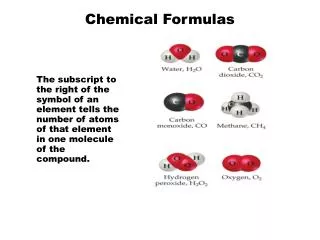
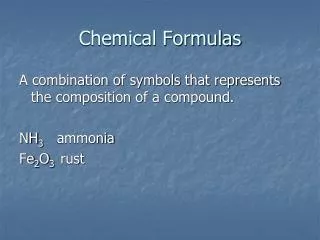
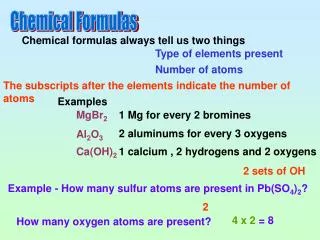
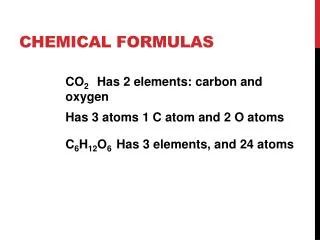
Chemical Formulas • CO2Has 2 elements: carbon and oxygen • Has 3 atoms 1 C atom and 2 O atoms • C6H12O6Has 3 elements, and 24 atoms
Naming ionic Compounds • First word NaCl • Cation-(positive ion) if the charge is always the same write the name of the metal. • Transition metals can have more than one type of charge. • Indicate the charge with Roman numerals in parenthesis.
Name these • Na+1 • Ca+2 • Al+3 • Fe+3 • Fe+2 • Pb+2 • Li+1
Second Word NaCl • Anions (negative ion) are always the same charge. • Change the element ending to – ide • Cl-1Chloride
Name these • Cl-1 • N-3 • Br-1 • O-2 • Ga+3
Write these • Sulfide ion • iodide ion • phosphide ion • Strontium ion
Polyatomic ions • Groups of atoms that stay together and have a charge. • Acetate C2H3O2-1 • Nitrate NO3-1 • Nitrite NO2-1 • Hydroxide OH-1 • Permanganate MnO4-1 • Cyanide CN-1
Naming Binary Ionic Compounds • Binary Compounds - 2 elements. • Ionic - a cation and an anion. • To write the names just name the two ions. • Easy with Representative elements. • Group A • NaCl = Na+ Cl- = sodium chloride • MgBr2 = Mg+2 Br- = magnesium bromide
Naming Binary Ionic Compounds • The problem comes with the transition metals. • Need to figure out their charges. • The compound must be neutral. • same number of + and – charges. • Use the anion to determine the charge on the positive ion.
Naming Binary Ionic Compounds • Write the name of CuO • Need the charge of Cu • O is -2 copper must be +2 • Copper (II) oxide • Name CoCl3 • Cl is -1 there are three of them = -3 • Co must be +3 • Cobalt (III) chloride
Naming Binary Ionic Compounds • Write the names of the following • KCl • Na3N • CrN • Sc3P2 • PbO • PbO2 • Na2Se
Polyatomic ions in compounds • At least three elements • NaNO3 • CaSO4 • CuSO3 • (NH4)2O
LiCN • Fe(OH)3 • (NH4)2CO3 • NiPO4
Writing Formulas • The charges have to add up to zero. • Get charges on pieces. • Cations from name of table. • Anions from table or polyatomic. • Balance the charges by adding subscripts. • Put polyatomics in parenthesis.
Writing Formulas • Write the formula for calcium chloride. • Calcium is Ca+2 • Chloride is Cl-1 • Ca+2 Cl-1 would have a +1 charge. • Need another Cl-1 • Ca+2 Cl2-1
Write the formulas for these • Lithium sulfide • tin (II) oxide • tin (IV) oxide • Magnesium fluoride • Copper (II) sulfate • Iron (III) phosphide • gallium nitrate • Iron (III) sulfide
Write the formulas for these • Ammonium chloride • ammonium sulfide • barium nitrate
Things to look for • If cations have (), the number is their charge. • If anions end in -ide they are probably off the periodic table (Monoatomic) • If anion ends in -ate or -ite it is polyatomic
Molecular compounds (Covalently bonded) • made of just nonmetals • smallest piece is a molecule • can’t be held together because of opposite charges. • can’t use charges to figure out how many of each atom
Easier • Molecular compounds name tells you the number of atoms. • Uses prefixes to tell you the number
Prefixes • 1 mono- 6 hexa- • 2 di- 7 hepta- • 3 tri- 8 octa- • 4 tetra- 9 nona- • 5 penta- 10 deca-
Prefixes • To write the name write two words • One exception is we don’t write mono- if there is only one of the first element. • No double vowels when writing names (oaoo) Prefix name Prefix name -ide
Name These • N2O • 2. NO2 • 3. Cl2O7 • 4. CBr4 • 5. CO2 • 6. BaCl2
Write formulas for these • 1. diphosphoruspentoxide • 2. tetraiodidenonoxide • 3. sulfur hexaflouride • 4. nitrogen trioxide • 5. Carbon tetrahydride • 6. phosphorus trifluoride • 7. aluminum chloride
Acids Writing names and Formulas
Acids • Compounds that give off hydrogen ions when dissolved in water. • Must have H in them. • will always be some H next to an anion. • The anion determines the name.
Naming acids • If the anion attached to hydrogen is ends in -ide, put the prefix hydro- and change -ide to -ic acid • HCl - hydrogen ion and chloride ion • hydrochloric acid • H2S hydrogen ion and sulfide ion • hydrosulfuric acid
Naming Acids • If the anion has oxygen in it • it ends in -ate of -ite • change the suffix -ate to -ic acid • HNO3 Hydrogen and nitrate ions • Nitric acid • change the suffix -iteto -ous acid • HNO2 Hydrogen and nitrite ions • Nitrous acid
Name these • 1. HF • 2. H3P • 3. H2SO4 • 4. H2SO3 • 5. HCN • 6. H2CrO4
Writing Formulas • Hydrogen will always be first • name will tell you the anion • make the charges cancel out. • Starts with hydro- no oxygen, -ide • no hydro, -ate comes from -ic, -itecomes from -ous
Write formulas for these • 1. hydroiodicacid • 2. acetic acid • 3. carbonic acid • 4. phosphorous acid • 5. hydrobromic acid